
Your Ads Stop. Your Traffic Stops. That Is the Real Problem.
You pause your Meta or Google Ads campaign for a weekend and your orders drop to near zero. Sound familiar? For most D2C brands selling kurtas, ethnic wear, shoes, and accessories in India, paid traffic is the only lifeline.
The truth is painful. Every rupee you spend on ads builds someone else’s platform, not your own asset. CPCs in fashion have risen over 40% in two years, and that trend is not reversing.
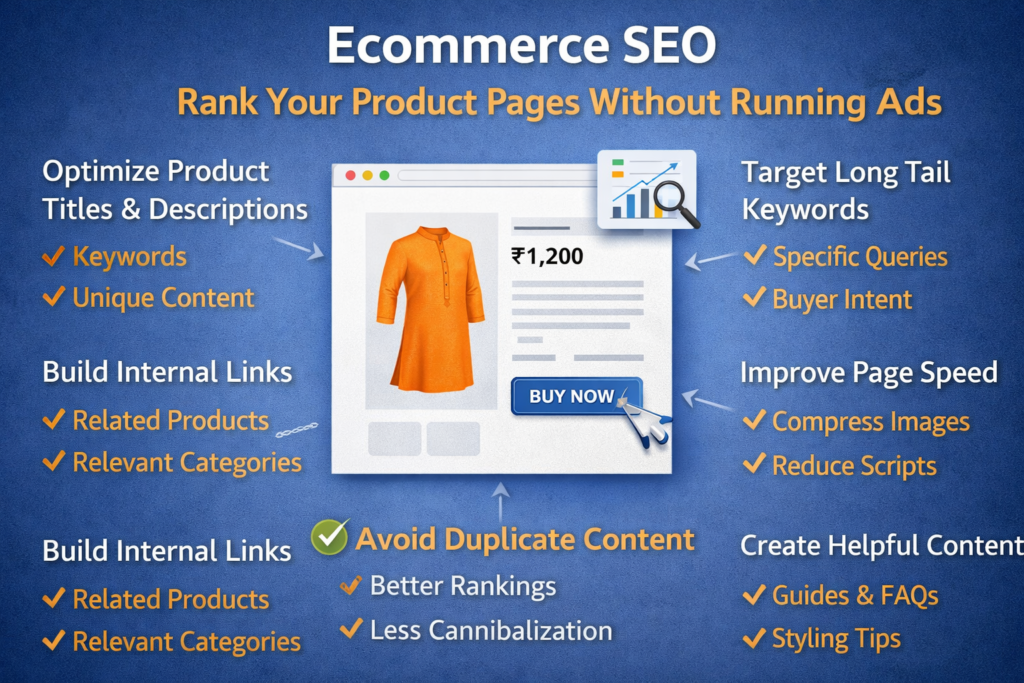
The solution is ranking your product pages organically. A strong ecommerce SEO strategy 2026 means your pages keep earning traffic long after the work is done, at zero incremental cost per click.
Why Product Pages Are Chronically Underoptimised
Most store managers focus SEO effort on the homepage and maybe one or two category pages. Product pages are uploaded in bulk, often with duplicate or manufacturer descriptions, and then forgotten.
Google sees hundreds of near-identical pages on your site with thin content and no keyword intent. It simply does not rank them. Fixing this is where the biggest organic wins live.
Start With Keyword Intent, Not Keyword Volume
High-volume keywords like kurta are dominated by Myntra and Ajio. You cannot win there. But cotton straight kurta for office under 1000 is a buyer who is ready to purchase right now.
Map one primary long-tail keyword to each product page. Use Google Search Console to find queries already generating impressions but no clicks. Those are your fastest wins.
Quick win: In Search Console, filter queries with more than 100 impressions and a CTR below 3%. Optimise the meta title of those pages this week.
Writing Product Descriptions That Google and Buyers Both Love
A great product description answers three questions: what is it, who is it for, and why should I buy it today. Include fabric type, occasion, fit, and care instructions since these match exactly how Indian shoppers search.
- Place your primary keyword in the first 80 words of the description
- Write a minimum of 200 unique words per product, never copy the supplier text
- Add occasion tags such as Diwali gifting or wedding guest outfit to capture seasonal intent
- Include size and styling tips to add natural secondary keywords without forcing them
Google sees hundreds of near-identical pages on your site with thin content and no keyword intent. It simply does not rank them. Fixing this is where the biggest organic wins live.
Start With Keyword Intent, Not Keyword Volume
High-volume keywords like kurta are dominated by Myntra and Ajio. You cannot win there. But cotton straight kurta for office under 1000 is a buyer who is ready to purchase right now. Map one primary long-tail keyword to each product page. Use Google Search Console to find queries already generating impressions but no clicks. Those are your fastest wins.
Writing Product Descriptions That Google and Buyers Both Love
A great product description answers three questions: what is it, who is it for, and why should I buy it today. Include fabric type, occasion, fit, and care instructions since these match exactly how Indian shoppers search.
- Place your primary keyword in the first 80 words of the description
- Write a minimum of 200 unique words per product, never copy the supplier text
- Add occasion tags such as Diwali gifting or wedding guest outfit to capture seasonal intent
- Include size and styling tips to add natural secondary keywords without forcing them
Optimising Titles, Meta Descriptions, and Image Alt Text
Your product title tag should lead with the keyword, not the brand. Jaipuri Block Print Anarkali Kurta | YourBrand outperforms YourBrand Kurta BPK2203 every single time. Write meta descriptions as a 155-character sales pitch. Include the keyword, a benefit, and a subtle nudge like free shipping above 499. Every product image needs a descriptive alt tag using natural language, not the product SKU code.
Internal Linking eCommerce SEO: Connect Your Pages Like a Web
Internal linking ecommerce SEO is the fastest free lever most managers never use. Every time you link from one page to another, you pass authority and tell Google which pages matter most on your site. Link your blog posts to relevant product pages. Link high-traffic category pages down to specific products. Link complementary products to each other, for example a kurta page linking to matching dupattas or ethnic footwear.
Schema Markup: Unlock Rich Results for Free
Product schema markup lets Google display your price, availability, and star ratings directly in search results. This dramatically improves click-through rates even if your ranking stays the same.
Most Shopify and WooCommerce themes include basic schema. Verify it is active using Google’s Rich Results Test tool and fix any missing fields like brand, currency, or review count.
Page Speed and Mobile UX Are Non-Negotiable
Over 80% of Indian fashion shoppers browse on mobile, mostly on mid-range Android devices with variable network speeds. A product page that loads in more than 3 seconds will not rank and will not convert.
- Convert all product images to WebP format and compress below 100KB
- Lazy load images below the fold so the first product photo appears instantly
- Remove unused apps and scripts that add JavaScript bloat to product pages
User-Generated Reviews Add Keyword-Rich Fresh Content
Customer reviews are free SEO content. A shopper who writes perfect kurta for my cousin’s sangeet, true to size and very soft fabric is naturally adding long-tail keywords you never had to write yourself.
Send a post-purchase email asking for a review. Incentivise with a small discount on the next order. Aim for at least 10 reviews per product before expecting meaningful organic ranking improvement.
Organic Traffic Is an Asset. Ads Are a Rental.
Every product page you optimise today is a compounding asset. Unlike ads that stop the moment budget runs out, a well-ranked product page keeps generating clicks, sessions, and revenue for months or years. The brands that commit to a real ecommerce SEO strategy 2026, with strong descriptions, solid internal linking ecommerce SEO, and technical hygiene, will own their categories without spending a rupee on ads.
How Digital Happiness Helps You Execute This Strategy
Reading about SEO strategy is one thing. Executing it consistently, while also managing inventory, logistics, and customer service, is another. That is exactly where Digital Happiness steps in.
Digital Happiness is a full-service digital marketing agency based in India, built specifically to help eCommerce brands grow their organic presence without depending on paid ads. Here is how each service maps directly to what your D2C store needs:
1. SEO Ranking and Product Page Optimisation
The team at Digital Happiness audits every product page on your store, identifies keyword gaps, and rewrites titles, descriptions, and meta tags to target high-intent, long-tail queries. For kurta and ethnic wear brands, this means showing up when buyers search for specific occasions, fabrics, and price ranges.
2. Technical SEO That Fixes What Is Hurting You
Slow pages, duplicate content, broken canonicals, missing schema markup. Digital Happiness runs a deep technical audit to uncover and fix every issue that is quietly suppressing your rankings. The result is a store that Google can crawl, understand, and rank with confidence.
3. Content Strategy and Internal Linking
The agency builds content clusters tailored to your product categories, with blog posts, buying guides, and style articles that all link back to your collection and product pages. This structured internal linking ecommerce SEO approach tells Google you are the authority in your niche, not just a listing page.
4. Conversion Booster for Product Pages
Ranking is only half the job. Digital Happiness also optimises your product pages for conversion, improving layout, trust signals, image quality guidance, and calls to action so that the traffic you earn actually turns into orders.
5. Local SEO and Google Presence
For D2C brands with a physical touchpoint or regional identity, Digital Happiness manages local SEO to capture searches like buy ethnic kurtas in Jaipur or handloom sarees near me, expanding your reach beyond just national queries.
6. Transparent Reporting and Growth Tracking
Every client gets regular, detailed reports covering keyword rankings, organic traffic, and revenue attribution. No black-box dashboards. You see exactly what is moving, what is not, and what is being done about it
Whether you are launching a new D2C kurta brand or scaling an existing ethnic wear store, Digital Happiness offers plans starting from an accessible entry point, with services covering technical SEO, content strategy, link building, and paid advertising when you need it.
Organic Traffic Is an Asset. Ads Are a Rental.
Every product page you optimise today is a compounding asset. Unlike ads that stop the moment budget runs out, a well-ranked product page keeps generating clicks, sessions, and revenue for months or years.
The brands that commit to a real ecommerce SEO strategy 2026, with strong descriptions, solid internal linking ecommerce SEO, and technical hygiene, will own their categories without spending a rupee on ads. Digital Happiness is the team that makes it happen.
Get Your Free SEO Audit
from Digital Happiness
Our team will review your top product pages, identify your biggest ranking opportunities, and hand you a clear, actionable plan — completely free, no strings attached.
Frequently Asked Questions
Everything you need to know about eCommerce SEO and how Digital Happiness can help your brand grow organically.