Is Your Website Invisible on Google?
Problem: You have a website. You have a great product or service. But when someone searches for you on Google, your competitors appear and you do not. You keep publishing content, yet nothing seems to move.
Agitation: Here is the painful truth. Your content is not the problem. The problem is hiding underneath your website in broken code, missing tags, slow loading pages, and crawl errors that Google sees every single day. These invisible technical issues are silently blocking every page you publish from ever ranking.
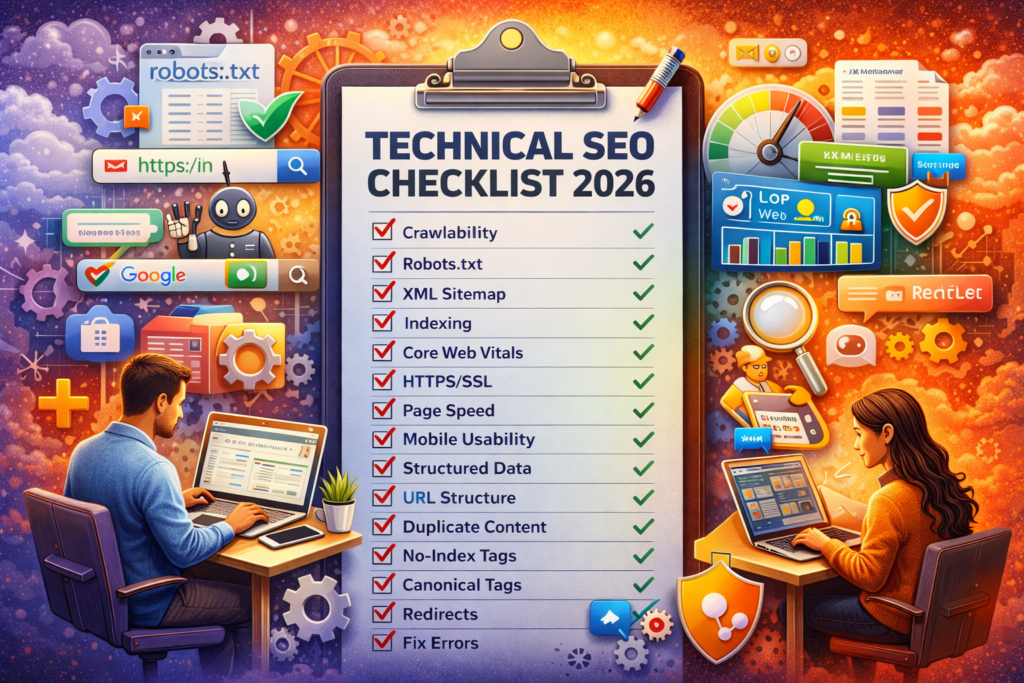
Solution: This Technical SEO checklist 2026 gives you 20 clear, actionable fixes you can action right now. No developer needed for most of them. No jargon. Just results.
Crawlability and Indexation Fixes
Fix 1: Check Your robots.txt File
Internal link opportunity: Technical SEO Services. Your robots.txt file tells Google what it can and cannot crawl. One wrong line can block your entire website from Google’s index. Open yourwebsite.com/robots.txt and make sure no important pages are blocked with Disallow rules.
Fix 2: Submit a Clean XML Sitemap
Go to Google Search Console and submit an updated XML sitemap. Your sitemap is Google’s map of your website. Only include pages you actually want indexed. Remove duplicate, low quality, and redirected pages from your sitemap immediately.
Fix 3: Fix All 404 Error Pages
Every broken link on your website wastes Google’s crawl budget. Use Google Search Console to find all 404 errors and set up 301 redirects to the most relevant live page. This recovers lost link authority and stops Google from wasting time on dead pages.
Fix 4: Remove Noindex Tags from Important Pages
This is one of the most common and damaging mistakes. A developer adds a noindex tag to a staging site and then pushes it live. Entire websites have disappeared from Google overnight because of this. Check every important page for unintended noindex tags immediately.
Core Web Vitals and Page Speed Fixes
Fix 5: Improve Your LCP Score
Internal link opportunity: Free Website SEO Audit. LCP stands for Largest Contentful Paint and measures how fast your main content loads. Google’s target is under 2.5 seconds. Compress all images and convert them to WebP or AVIF format. This single fix can dramatically improve your LCP score.
Fix 6: Fix Your INP Score
INP stands for Interaction to Next Paint and replaced FID as a Core Web Vital in 2026. It measures how quickly your page responds when a user clicks or taps. Remove unused JavaScript and third party tracking scripts that are slowing down your page response time.
Fix 7: Eliminate CLS Issues
CLS stands for Cumulative Layout Shift and measures how much your page jumps around while loading. Always set explicit width and height attributes on every image and video. Unstable pages frustrate users and are penalised by Google directly.
Fix 8: Enable Browser Caching
If visitors have to fully reload your website every time they visit, your page is too slow. Enable browser caching so returning visitors experience near instant load times. This also reduces your server load significantly.
HTTPS and Security Fixes
Fix 9: Switch Every Page to HTTPS
Internal link opportunity: Technical SEO Audit. Google confirmed HTTPS as a direct ranking factor. Every page on your site must load over HTTPS. Set up 301 redirects from all HTTP versions to their HTTPS equivalents and ensure your SSL certificate is valid and not expired.
Fix 10: Fix Mixed Content Warnings
Mixed content happens when a secure HTTPS page loads insecure HTTP resources like images or scripts. Browsers show security warnings to users and Google penalises this. Audit all internal resources and update every URL to HTTPS.
On Page Technical Fixes
Fix 11: Write Unique Meta Titles and Descriptions
Every page must have a unique meta title and meta description. Duplicate meta tags confuse Google about which page to rank. Keep meta titles under 60 characters and meta descriptions under 160 characters and include your focus keyword naturally in both.
Fix 12: Fix Duplicate Content Issues
Internal link opportunity: SEO Ranking Services. Duplicate content dilutes your ranking power. Add canonical tags to tell Google which version of a page is the original. This is especially critical for eCommerce sites with product pages that share similar descriptions.
Fix 13: Optimise All Image Alt Text
Every image on your website needs a descriptive alt text attribute that includes your target keyword where relevant. This helps Google understand your images and makes your website accessible. It also helps you rank in Google Image Search, which drives additional traffic.
Fix 14: Fix Broken Internal Links
Broken internal links waste crawl budget and create a poor user experience. Use a free tool like Screaming Frog to crawl your website and find all broken internal links. Update them to point to live, relevant pages.
Schema Markup and Structured Data Fixes
Fix 15: Add Article Schema to Every Blog Post
Internal link opportunity: Content Strategy Services. Schema markup tells Google exactly what your content is about in language it understands. Add Article schema to every blog post. This dramatically improves your chances of appearing in Google AI Overviews and featured snippets in 2026.
Fix 16: Add FAQ Schema to FAQ Sections
If your page includes a FAQ section, add FAQ schema markup. This makes your answers eligible for Google’s People Also Ask section, which drives significant additional traffic without needing to rank higher.
Fix 17: Add Local Business Schema
For local businesses, Local Business schema tells Google your business name, address, phone number, opening hours, and service area. This directly boosts your local SEO rankings and improves your visibility on Google Maps.
Mobile and AI Readiness Fixes
Fix 18: Pass Google’s Mobile Friendly Test
Internal link opportunity: Web Booster Services. Google uses mobile first indexing in 2026, meaning it ranks the mobile version of your website first. Run Google’s Mobile Friendly Test on every key page. Fix text that is too small, buttons that are too close together, and content that is wider than the screen.
Fix 19: Make Your Website AI Crawler Friendly
In 2026, AI search engines like ChatGPT, Perplexity, and Google AI Overviews crawl your website to find information. Make sure your robots.txt does not block AI crawlers if you want to be cited in AI answers. Structure every page with clear headings, concise answers, and authoritative facts.
Fix 20: Install and Connect Google Search Console
If you do not have Google Search Console connected to your website, you are flying blind. It shows you every indexation error, crawl issue, Core Web Vital failure, and manual penalty affecting your rankings. This free tool is the most important technical SEO tool available and should be checked every single week.
How Digital Happiness Helps With Technical SEO

At Digital Happiness, we help businesses fix technical SEO problems and build a strong website foundation so search engines can easily crawl, index, and rank their pages. Technical SEO includes optimizing site speed, sitemap, robots.txt, indexing, mobile usability, and overall website structure, all of which are essential for higher rankings.
Many websites have good content but still do not rank because search engines cannot properly access the site. Our team ensures that your website is fully optimized so Google can understand and trust it.
What Digital Happiness Does for Your Website
- Fix robots.txt errors
- Create and submit XML sitemap
- Improve website speed
- Fix indexing issues
- Optimize URL structure
- Mobile SEO optimization
- Core Web Vitals improvement
- Technical SEO audit
- On-page SEO optimization
- Backlink strategy
Technical SEO is the foundation of SEO, and without it, even the best content may not rank in search engines. Our goal at Digital Happiness is to make sure your website is technically strong so it can grow faster in Google search results.
Why Choose Digital Happiness
Digital Happiness uses advanced SEO tools and AI-powered analysis to find problems that most agencies miss. We focus on long-term growth, not shortcuts, so your website can rank safely and consistently.
We help with:
- Technical SEO
- On-Page SEO
- Off-Page SEO
- AI SEO
- Local SEO
- Content SEO
- Backlink building
With the right technical setup, your website becomes easier for search engines to crawl, which improves visibility and traffic.
Conclusion: Your Rankings Are One Technical Audit Away
The Technical SEO checklist 2026 above covers the 20 most impactful fixes your website needs right now. Most of these do not require a developer. They require attention, the right tools, and a commitment to fixing the foundation before building higher. Your content deserves to rank. Your business deserves to be found. Technical SEO is the invisible layer that makes everything else work.
Start with Fix 1 today. Work through the list. Or let Digital Happiness do it for you
Get Your FREE Technical SEO Audit Today
Find out exactly which of these 20 technical issues are hurting your rankings right now. Digital Happiness will audit your website for free and show you a clear action plan.
Visit: digitalhappiness.in
Email: sam@digitalhappiness.in
Call: +91 70091 06028
© 2026 Digital Happiness. All Rights Reserved. digitalhappiness.in