The Question Every Small Business Owner Asks
You hired an SEO agency, started publishing content, and optimized your website. A few weeks pass. You check Google and you are still nowhere to be found. A familiar frustration creeps in: Is this actually working?
This is the moment many small businesses make their biggest SEO mistake. They abandon a strategy that was just beginning to gain momentum, switch agencies, or pivot to paid ads resetting all the progress they had quietly built. The painful reality is that SEO is not a switch you flip. It is a compounding investment, and understanding its timeline is the single most important thing you can do to protect that investment.
The solution is simple: set the right expectations from day one. This guide gives small business owners a clear, honest, month-by-month picture of how long SEO takes to show results, what is happening behind the scenes at each stage, and exactly how to maximize your progress along the way.
The Honest Answer: SEO Takes 3 to 6 Months for Most Small Businesses
If anyone promises you first-page Google rankings in 2 to 4 weeks, walk away. That is either a misrepresentation or a shortcut that will eventually trigger a Google penalty. The honest, data-backed answer is that most small businesses begin seeing meaningful SEO results between 3 and 6 months of consistent, well-executed effort. For highly competitive industries or brand-new websites with zero authority, the timeline can stretch to 9 to 12 months before substantial organic traffic arrives. For businesses in low-competition local niches with solid technical foundations, results can emerge sooner sometimes within 60 to 90 days.
Why SEO Takes Time: The Mechanics Behind the Delay
Understanding why SEO takes time removes the anxiety from the waiting period. It is not that nothing is happening, it is that Google’s process of discovering, evaluating, and rewarding your content has several distinct stages that cannot be rushed.
Stage 1: Crawling and Indexing
Before Google can rank your content, it must first find and index it. Googlebot crawls the web continuously, but new or updated pages can take days to weeks to be discovered and added to Google’s index. Submitting an XML sitemap to Google Search Console accelerates this process significantly.
Stage 2: Authority Assessment
Once indexed, Google assesses how much it should trust your website. This assessment is based on dozens of signals including your backlink profile, domain age, content quality, user engagement metrics, and technical health. New websites naturally have low authority, and building it takes consistent time and effort.
Stage 3: Ranking Stabilization
Even after a page starts ranking, its position fluctuates significantly in the early months a period SEOs call the Google Sandbox effect. Google is testing how users interact with your content. Pages that hold their rankings over time signal quality, and Google gradually rewards them with more stable, higher positions.
Month-by-Month SEO Timeline for Small Businesses
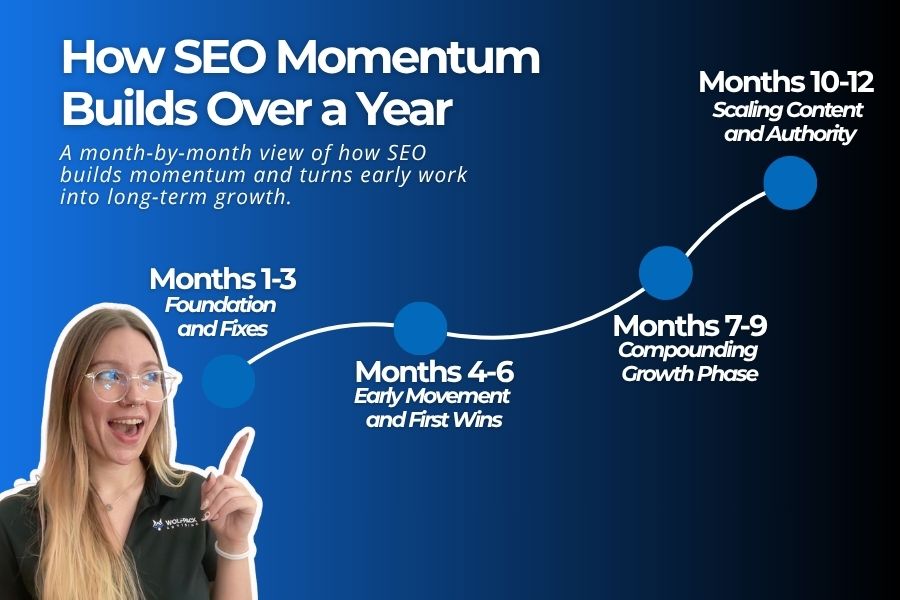
Here is a realistic breakdown of what you should expect and what your SEO agency should be doing at each stage of the journey:
| Timeframe | What Happens | What to Focus On |
| Month 1–2 | Foundation & auditing | Technical fixes, GBP setup, keyword research, on-page optimization |
| Month 3 | Early signals | Crawl improvements, minor ranking shifts, citation consistency |
| Month 4–5 | Rankings emerge | Page 2–3 rankings, increased impressions, content gaining traction |
| Month 6 | Real traffic growth | Page 1 rankings for low-competition keywords, measurable traffic |
| Month 9–12 | Compounding results | Sustained traffic, leads from organic search, authority building |
Month 1 to 2: Building the Foundation
The first two months of any SEO campaign are the least glamorous but the most critical. This is where your SEO foundation is built and the strength of that foundation determines how fast everything above it grows.
During this phase, your SEO agency should be:
- Running a full technical SEO audit to identify and fix crawl errors, broken links, slow page speeds, and indexing issues.
- Conducting in-depth keyword research to map target keywords to every page on your website.
- Optimizing all on-page elements including title tags, meta descriptions, H1 tags, and image alt text.
- Setting up Google Search Console and Analytics to establish baseline tracking.
- Auditing and cleaning up local citations for NAP consistency if local SEO is part of the strategy.
Month 3 to 4: Early Signals Start to Appear
This is where patience begins to pay off. By month three, Google has had time to re-crawl your improved pages and process your new content. You will start seeing early ranking signals movement from page 5 to page 3, increased impressions in Search Console, and your content appearing for long-tail keyword variations.
These signals are not yet converting into traffic surges, but they are proof that the strategy is working. This is the critical window where many small businesses mistakenly panic and pull the plug right before the results they have been waiting for begin to materialize.
What should be happening in month 3 to 4:
- Content publishing accelerates, blog posts, location pages, and service pages are being optimized and added consistently.
- Backlink outreach begins, guest posts, local partnerships, and directory submissions build domain authority.
- Rank tracking data becomes meaningful, you can now see directional movement on target keywords.
- Google Business Profile is fully active, local businesses should be seeing improved Map Pack visibility.
Low and medium-competition keywords particularly local and long-tail phrases begin reaching page 1. If your Google Business Profile has been optimized, local Map Pack rankings strengthen considerably. Content published in months 1 and 2 has now had time to build authority and attract organic backlinks naturally.
This is where patience begins to pay off. By month three, Google has had time to re-crawl your improved pages and process your new content. You will start seeing early ranking signals movement from page 5 to page 3, increased impressions in Search Console, and your content appearing for long-tail keyword variations.
Month 5 to 6: Real Traffic Growth Begins
Month 5 and 6 are when SEO becomes visible to the business. For most small businesses, this is when organic traffic meaningfully increases, when the phone starts ringing from Google searches, and when your investment begins to feel justified.
Low and medium-competition keywords particularly local and long-tail phrases begin reaching page 1. If your Google Business Profile has been optimized, local Map Pack rankings strengthen considerably. Content published in months 1 and 2 has now had time to build authority and attract organic backlinks naturally.
Month 9 to 12: Compounding Results and Long-Term Dominance
Businesses that stay the course past the 6-month mark enter what experienced SEOs call the compounding phase. Every new piece of content builds on the authority of what came before. Every new backlink amplifies your existing ones. Rankings become more stable, traffic grows more predictably, and the cost per organic lead drops significantly.
By month 12, businesses with a consistent SEO strategy in place are typically ranking for 10 to 30 target keywords, generating steady organic traffic, and seeing SEO become one of their most cost-effective lead generation channels. This is the point where the ROI of SEO becomes undeniable compared to paid advertising.
5 Factors That Determine How Fast Your SEO Shows Results
Not all businesses will follow the exact same timeline. These five factors have the greatest impact on how quickly your SEO results arrive:
- Website age and existing authority: Older domains with existing content rank faster than brand-new websites starting from zero.
- Keyword competition level: Targeting low-competition local and long-tail keywords delivers results significantly faster than competing for broad, high-volume national terms.
- Content quality and publishing frequency: Businesses that publish high-quality, well-optimized content consistently every week outrank those publishing sporadically.
- Technical SEO health: A website with crawl errors, slow load times, or duplicate content issues will rank slower regardless of content quality.
- Backlink profile strength: Websites that actively build high-quality backlinks see ranking improvements 30 to 50 percent faster than those relying on content alone.
What You Can Do to Speed Up SEO Results
While there is no shortcut around Google’s process, these actions consistently accelerate timelines for small businesses:
- Fix technical issues immediately. A clean, crawlable website is indexed faster. Use Google Search Console to identify and resolve errors in the first two weeks.
- Focus on low-competition keywords first. Win quick rankings on long-tail, local, and niche-specific keywords to build domain confidence before targeting broader terms.
- Publish consistently. Two well-optimized pieces of content per week will outperform one exceptional piece per month. Consistency signals to Google that your site is active and growing.
- Build local backlinks actively. Chamber of Commerce listings, local news features, and community sponsorships earn high-trust local backlinks that accelerate rankings in your service area.
- Leverage AI-powered SEO tools. Platforms like Search Atlas dramatically reduce the time needed for keyword research, content optimization, and gap analysis compressing months of manual work into days.
Conclusion: Patience Is the Most Powerful SEO Strategy
SEO is not a magic trick. It is a long-term business asset like building a reputation or a loyal customer base. The businesses that understand this and commit to the process consistently are the ones that dominate their local markets, attract steady organic leads, and reduce their dependence on expensive paid advertising over time.
The timeline feels slow in the early months. But by month 6, 9, and 12, the compounding power of consistent SEO becomes impossible to ignore. The best time to start was six months ago. The second-best time is today.
FAQs
Here is exactly how Digital Happiness maps to every stage of the SEO timeline from the blog post.
Month 1–2: Foundation Building
What needs to happen: Technical audit, keyword research, on-page fixes, Search Console setup, citation cleanup
How Digital Happiness helps:
- Technical SEO service — runs a full website inspection to fix crawl errors, broken links, slow speeds, and indexing issues from day one
- Web Booster service — optimizes page speed, mobile responsiveness, and Core Web Vitals so Google can crawl and index your site faster
- Analytics service — sets up Google Analytics 4 and Search Console to establish a proper tracking baseline before any content or link work begins
- Local SEO service — audits and corrects NAP consistency across all directories in the first month so your local foundation is clean
Month 3–4: Early Signals
What needs to happen: Content publishing, backlink outreach, local visibility improvements
How Digital Happiness helps:
- Content Strategy service — creates and publishes SEO-optimized blog posts, location pages, and service pages consistently to trigger early ranking signals
- Search Marketing service — targets the right local and long-tail keywords at the right intent level to generate early page 2–3 rankings
- Link Building service — begins outreach for guest posts, local partnerships, and directory submissions to build domain authority during this critical window
- Local SEO service — fully activates and optimizes your Google Business Profile so Map Pack visibility starts improving from month 3
Month 5–6: Real Traffic Growth
What needs to happen: Rankings consolidate, organic traffic grows, leads start arriving
How Digital Happiness helps:
- SEO Ranking service — tracks keyword movement weekly and doubles down on content and links for pages that are close to page 1 breakthroughs
- Search Atlas SEO platform — Digital Happiness uses Search Atlas to run AI-powered content gap analysis, identifying new keyword opportunities that competitors are missing, accelerating ranking growth
- Conversion service — optimizes landing pages so the traffic arriving from organic search actually converts into enquiries, calls, and sales
- Funneling service — builds lead nurturing sequences so organic visitors who don’t convert immediately are recaptured through email and retargeting
Month 9–12: Compounding Results
What needs to happen: Authority builds, rankings stabilize, leads compound
How Digital Happiness helps:
- Authority Building service — builds E-E-A-T signals including author profiles, expert citations, and PR features that lock in Google’s trust for the long term
- Analytics service — delivers monthly performance reports showing exactly which keywords are driving revenue, so strategy is refined based on real business data not vanity metrics
- Campaign Management service — runs integrated campaigns combining SEO, social media, and email to amplify organic reach and maximize ROI from every ranking gained
- Smart Ads service — for keywords that are still competitive at month 9–12, Digital Happiness layers in targeted PPC to capture traffic while organic rankings continue building
The Biggest Advantage Digital Happiness Brings
| What Most Agencies Do | What Digital Happiness Does |
|---|---|
| Generic monthly reports | Transparent month-by-month milestone reporting |
| One-size-fits-all strategy | Custom strategy built around your industry and competition level |
| SEO only | Full-service: SEO + Social + Email + Ads + Analytics working together |
| Manual keyword research | AI-powered Search Atlas for faster, deeper keyword and content intelligence |
| Lock-in contracts | Flexible, no lock-in — results earn your retention |
| Slow to fix technical issues | Web inspection and technical fixes in month 1 before any content work begins |
The Short Answer
Digital Happiness covers every single stage of the SEO timeline — from the unsexy technical groundwork in month 1 to the compounding authority building in month 12. And because it is a one-stop agency, your SEO, content, social media, ads, and analytics are all aligned under one strategy rather than siloed across multiple vendors pulling in different directions.