
Is Google Ignoring Your Website?
Problem: You are publishing blogs, adding keywords, and waiting. But your pages are still not ranking. Your competitors keep climbing above you and you cannot figure out why. The content is good. The keywords are right. So what is missing?
Agitation: The answer is hiding in plain sight. Your website pages are isolated islands with no connections between them. Google cannot understand which pages are most important, which topics you are an expert on, or how your content relates to each other. Every day without a proper internal linking SEO strategy 2026 is a day your entire website is underperforming.
Solution: Internal linking is the single most powerful and completely free SEO tactic available to you right now. When done correctly, it tells Google exactly what your website is about, which pages deserve to rank, and why you are the authority in your niche.
What is Internal Linking and Why Does It Matter in 2026 ?
An internal link is a hyperlink on one page of your website that points to another page on the same website. Simple in concept but extremely powerful in practice. In 2026, internal links do three critical things: they help Google discover and crawl all your pages, they distribute ranking authority from strong pages to weaker ones, and they tell Google which pages are the most important on your site.
The Pillar and Cluster Model: The Most Powerful Structure in 2026
The most effective internal linking SEO strategy 2026 is the topic cluster model. You create one large pillar page covering a broad topic, then surround it with cluster pages covering specific subtopics. All cluster pages link back to the pillar page and the pillar links out to all cluster pages.
For example, Digital Happiness has a main SEO Services page. Cluster pages include Technical SEO, Local SEO, and Content Strategy. Every cluster page links back to SEO Services and every service page links to all related clusters. This signals deep expertise to Google across the entire topic.
How to Use Anchor Text Correctly ?
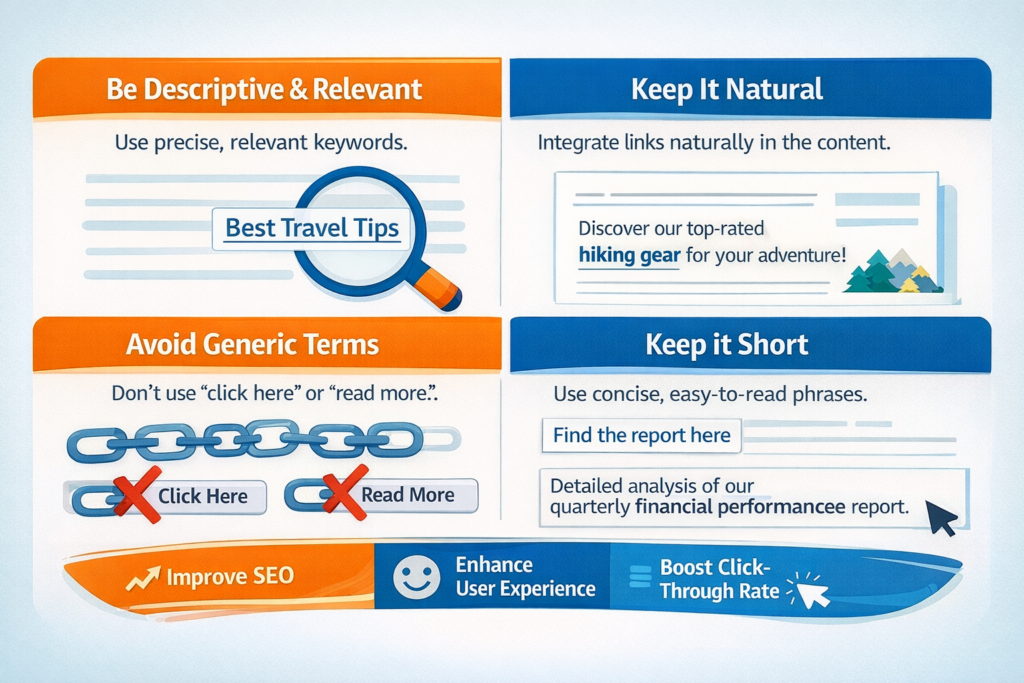
Anchor text is the clickable words used in your internal link. Using the right anchor text is just as important as the link itself.
Best practices for anchor text:
- Use descriptive keywords that clearly describe the page you are linking to
- Never use click here or read more as anchor text. They tell Google nothing.
- Use varied anchor text for the same page. Exact match overuse triggers algorithmic scrutiny.
- Keep anchor text natural and relevant to the surrounding content
The 3 Click Rule: Keep Every Page Close to Home
Internal link opportunity: Free Website SEO Audit. Every important page on your website should be reachable within 3 clicks from your homepage. Pages buried deeper than this receive little crawl attention and almost no link authority from Google. Run a quick test. Can you reach your most important service pages in 3 clicks or less? If not, your site structure needs fixing and Digital Happiness can audit this for you completely free.
How Many Internal Links Should Each Page Have?
Based on current 2026 best practices, aim for 2 to 5 contextual internal links per 1,000 words. For a standard blog post of 1,500 words, 5 to 7 internal links is the ideal range. Keep the total number of links on any page under 150. Google stops following links past this threshold. Quality and relevance always beats quantity when it comes to internal linking.
Fix Orphan Pages Immediately
Internal link opportunity: Technical SEO Services. An orphan page is a page that has zero internal links pointing to it. Google rarely finds or ranks orphan pages because there is no path leading to them from the rest of your site.
Use Google Search Console or Screaming Frog to find all orphan pages on your website. Then add relevant internal links from related content pages to bring these pages back into your site structure.
Common Internal Linking Mistakes to Avoid
- Linking to your homepage excessively: Your homepage already has the most authority. Link to service and content pages instead.
- Using footer links for SEO: Google treats excessive footer links as spam since 2013. Use contextual in content links instead.
- Keyword cannibalisation: Using the same anchor text for two different pages confuses Google about which page to rank.
- Ignoring new content: Every new blog post needs internal links added from existing pages within 48 hours of publishing.
No linking plan: Random linking without a strategy wastes authority and confuses Google’s understanding of your site.
How Digital Happiness Builds Internal Linking Strategies for Clients
At Digital Happiness, internal linking is built into every single SEO campaign from day one. We do not treat it as an afterthought.
Here is what we do for every client:
- Full site audit to identify orphan pages and broken internal link structures
- Topic cluster mapping that aligns your service pages with your blog content
- Anchor text optimisation across every page on your website
- Monthly internal link audits to update links as new content is published
- Search Atlas powered crawl analysis to ensure Google finds every important page
The result? Faster indexation, stronger topical authority, and higher rankings without spending a single rupee on paid ads. One of our clients saw a 23% rise in organic traffic within 60 days of restructuring their internal links alone.
Conclusion: Internal Linking is Free SEO Power You Are Leaving on the Table
Your internal linking SEO strategy 2026 is the most powerful SEO lever you completely control. No agency outreach. No budget required. Just smart connections between your existing pages.
Start with your pillar pages. Fix your orphan pages. Add 2 to 5 internal links to every new blog post. And let Digital Happiness do the heavy lifting with a free audit of your entire link structure today.
Find out exactly which pages are orphaned, which links are broken, and how to fix your internal structure to start ranking higher on Google this week.
Claim Your Free Audit Now