
By Digital Happiness Team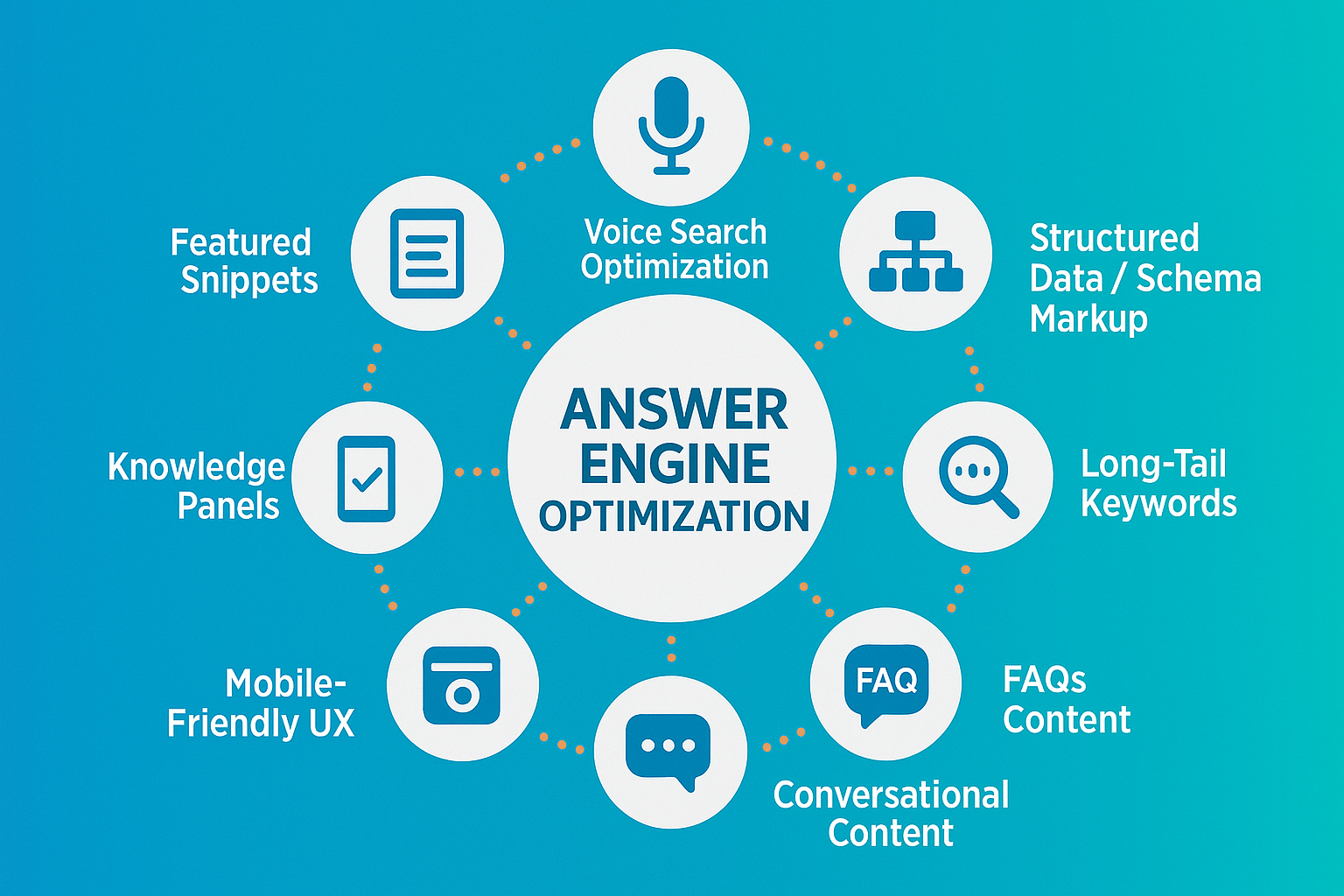
Search has changed forever. Your customers are getting answers from ChatGPT, Google AI Overviews, and Perplexity not clicking your links. Here is exactly what AEO is and how to make your brand the one that gets cited.
At Digital Happiness, we work with businesses navigating exactly this shift. This guide explains what Answer Engine Optimization is, why it matters right now, how it differs from traditional SEO, and most importantly the practical steps you can take to prepare.
What is Answer Engine Optimization?
Definition
Answer Engine Optimization (AEO) is the practice of structuring and enhancing your content so that AI-powered platforms like ChatGPT, Google AI Overviews, Perplexity, and Microsoft Copilot select your brand as a cited source when generating direct answers to user questions.
Traditional SEO was built around a clear sequence: a user searched, Google returned a list of ranked pages, the user clicked one. That sequence has fractured. Today, users increasingly receive synthesized answers in conversational interfaces, and the page they visit if they visit one at all is often a source cited inside that answer, not a search result they independently chose.
Why Answer Engine Optimization Matters in 2026: The Numbers Are Undeniable
This is not a niche technical topic. The scale of the shift toward AI-powered search has reached a tipping point that affects every business with an online presence.
ChatGPT reached 800 million weekly active users by October 2025, more than a 2.6× increase in less than a year. Meanwhile, Google AI Overviews now appear in approximately 30% of all searches and 74% of problem-solving queries. Gartner predicts traditional search volume will drop 25% by 2026 due to AI chatbots and virtual agents. For content teams, the implication is clear: optimizing only for Google is no longer enough.The stakes are also higher on the buyer-journey side.
Answer Engine Optimization vs Search Engine Optimization : What Actually Changes?
The most important thing to understand about AEO SEO is this: AEO does not replace SEO. It builds on top of it. You cannot win in AI search without a solid SEO foundation. But SEO alone is no longer sufficient.
Dimension | Traditional SEO | Answer Engine Optimization (AEO) |
|---|---|---|
| Primary goal | Rank on Google’s results page | Get cited inside AI-generated answers |
| Success metric | Rankings, organic clicks, CTR | AI citation rate, brand mentions in answers |
| Content format | Long-form, keyword-rich articles | Structured Q&A, concise direct answers, FAQs |
| Technical focus | Crawlability, page speed, meta tags | Schema markup, structured data, entity clarity |
| Link building | Backlinks for authority signals | Earned media, PR coverage, cross-platform mentions |
| User behaviour | Click-through from SERP | Zero-click discovery; brand awareness before the visit |
| Query type | Short keyword queries (avg. 3–4 words) | Conversational prompts (avg. 23 words per ChatGPT prompt) |
SEO relies on keyword research, backlinking, metadata optimization, and UX improvements, while AEO emphasizes structured data like schema markup, FAQ formats, featured snippets, and content that AI language models can easily summarize and present to users.
The Answer Engines You Need to Optimize -Answer Engine Optimization
AEO is not a single-platform strategy. Your brand needs to earn citations across the ecosystem of AI-powered answer surfaces. Each has its own preferences.
- Google AI Overviews: Appearing in up to 30% of all searches. Prioritizes pages that already rank well organically and have structured FAQ/How To schema. AI overview optimization begins with strong SEO fundamentals.
- ChatGPT Search:Reaches 900M+ monthly users. Prioritises neutral, authoritative content with external citations and clear entity definitions. Press coverage significantly boosts citation likelihood.
- Perplexity AI:Favours conversational, experience-based answers with practical examples. Strong on citing specific data points, so pages with original statistics perform well.
- Microsoft Copilot: Draws heavily from Bing’s index. Responds well to pages with structured headers, clear schema, and well-organized topic clusters. Treat Bing SEO as a non-negotiable.
How to Prepare for AEO: 7 Actionable Strategies
Below are the core strategies that form a results-driven AEO implementation. These are not theoretical they are the exact frameworks we apply for clients at Digital Happiness as part of our AI SEO service.
1. Adopt an Answer-First Content Format
The inverted triangle technique that journalists have used for years is the backbone of AEO content: lead with the answer, then provide supporting context. Every piece of content should have a clear, standalone answer within the first 2–3 sentences of each section. AI systems need to be able to extract your answer without reading the entire article. Write short paragraphs of 3–4 lines with direct headers. Structure creates citability.
2. Implement Schema Markup (Structured Data)
Pages with FAQ schema are 3.2× more likely to appear in Google AI Overviews compared to pages without FAQ structured data. Schema is the machine-readable layer that tells AI systems what your content is about not just that it contains relevant words. The most important schema types for AEO are FAQ Page, How To, Article, Organization, and Local Business. Below is a minimal FAQ Page schema example: FAQ Page Schema JSON-LD
3. Build Topical Authority Through Content Clusters
Topic clusters replace single keywords as the dominant AEO strategy. One-off articles are being superseded by comprehensive clusters that cover a subject from every angle. Choose a core theme relevant to your business for example, “SEO for service businesses and publish 8–12 tightly linked articles that each address a specific question within that theme. Anchor them around a detailed pillar page.
4. Optimize for Entity Clarity
AI systems map the world using entities people, brands, products, and concepts. If your content does not clearly define and reinforce these, you risk being invisible to LLMs. Use consistent terminology, reinforce your brand name, location, services, and value proposition across your website, Google Business Profile, Wikipedia/Wiki data (if applicable), industry directories, and PR coverage. Entity-driven content improved AI citation likelihood by more than 35% across major generative search platforms, according to Search Engine Land.
5. Prioritize E-E-A-T Signals
AI systems are trust machines. They cite sources they can verify as expert and authoritative. Google’s E-E-A-T framework Experience, Expertise, Authoritativeness, Trustworthiness is the primary signal AI relies on when deciding whose content to surface. This means attributing content to named authors with real credentials, earning editorial backlinks from respected industry publications, accumulating positive reviews across multiple platforms, and building a consistent, credible brand presence across the open web. According to Muck Rack’s Generative Pulse 2025 report, 82% of links cited by AI are from earned media sources, including journalistic coverage and third-party blogs. PR is now an AEO strategy.
6. Optimize for Conversational, Long-Tail Questions
The US average query length in traditional search is 3.37 words. In contrast, the average prompt length in ChatGPT is 23 words. This means your keyword strategy for AEO needs to include full questions, not just keywords. Research the exact questions your audience asks what the best SEO strategy for a small business is in India. How long does it take for local SEO to work and build content that answers these with precision. Use the People Also Ask section in Google and tools like Answer.
7. Nail the Technical SEO Foundation First
AEO cannot function on a broken website. Without technical SEO, even perfect schema markup can get lost in technical noise duplicate content, mobile formatting issues, orphan pages, and sites with poor loading speed. Before any AEO initiative, ensure your site is fast (Core Web Vitals), mobile-optimized, fully crawlable, free of duplicate content, and using clean internal linking. These are not just good SEO practices they are prerequisites for AI systems to parse, trust, and cite your content reliably.
6 Trust Signals That Drive AI Citations-Answer Engine Optimization
For most businesses, the real challenge is not choosing between AEO and SEO it is building a search strategy that works in both environments at once. The brands winning now are building a system where technical SEO, content design, authority building, structured data, user experience, and entity clarity all work together. Here is how each signal contributes:
- Content Clarity: AI needs to extract a single, clear answer from your page. Structured headers, short paragraphs, and answer-first writing win.
- Information Gain: Original data, proprietary insights, and first-hand expertise that cannot be found elsewhere make AI systems prefer you over generic sources.
- Semantic Structure: Schema markup, proper H-tag hierarchy, and FAQ formats give machines explicit context about your content’s intent and meaning.
- Cross-Web Consistency: Consistent brand mentions, citations, and entity information across your website, directories, social profiles, and earned media reinforce AI trust.
- Demonstrated Authority: Editorial backlinks, author credentials, and media coverage signal to AI systems that your brand is a verified expert in its domain.
- Technical Accessibility: Fast loading, clean crawlability, and HTML-based content (not hidden in JavaScript) let AI systems access and index your content reliably.
How to Measure-Answer Engine Optimization
Traditional SEO metrics rankings and organic clicks- only tell part of the story in an AI-first world. A results-driven AI SEO service needs to track new signals:
- AI citation rate: How often does your brand appear when relevant questions are asked directly in ChatGPT, Perplexity, and Google AI Overviews? Run weekly manual tests on your core queries.
- Share of voice in AI answers: Are your competitors being cited when they should not be? Track both your citations and theirs.
- AI-referred sessions in GA4: Segment traffic from ChatGPT, Perplexity, and other AI referrers. These sessions are currently under-tracked and high-value.
- Featured snippet and AI Overview inclusion rate: Track how many of your target queries now trigger an AI Overview that includes your domain.
- Conversion rate by source: AI-referred visitors frequently convert at higher rates but only if you track them separately from standard organic traffic.
- Brand entity search volume: As AEO builds your authority, branded search people searching directly for your business name should increase. This is a strong long-term indicator.
Common AEO Mistakes to Avoid-Answer Engine Optimization
AEO is still new -and many agencies are already getting it wrong. Here are the most common mistakes we see when auditing businesses’ AI search readiness.Ignoring traditional SEO fundamentals is the biggest AEO mistake. AEO does not replace SEO; it builds on it.
Other critical errors include using generic schema markup like thing instead of specific types like Product or FAQ Page; neglecting semantic HTML5 structure and proper header hierarchy; assuming one optimization strategy works across all AI platforms when each has distinct preferences; and abandoning proven SEO foundations in favor of untested AEO tactics.
Answer Engine Optimization and search Engine Optimization : The Integrated Strategy for 2026
The most practical framing is this: SEO is the infrastructure. AEO is the layer on top that gets you cited, not just ranked.The winning playbook combines both: strong technical SEO so AI can crawl and trust your site -authoritative, structured content so AI can cite it – entity consistency and PR so AI recognizes your brand as a legitimate source – ongoing measurement so you iterate faster than competitors.
Effective AEO follows three main pillars: build consensus (reinforce consistent facts and brand messages across all platforms so AI engines trust your information); provide information gain (offer unique data, original insights, or expert opinions that add value beyond what is already online); and use semantic structure (organise your content with schema markup, headings, lists, and FAQs so AI models can easily parse and cite it).
Frequently Asked Questions About -Answer Engine Optimization
- Is Answer Engine Optimization the same as SEO?
No, but they work together. SEO optimizes your content to rank on traditional search engines like Google. AEO optimizes your content to be cited inside AI-generated answers on platforms like ChatGPT and Google AI Overviews. You need both SEO provides the foundation; AEO builds the AI visibility layer on top of it.
- How long does AEO take to show results?
Businesses with strong domain authority and well-structured content often see citations begin appearing in AI responses within 4–6 weeks of implementing AEO optimisations. However, consistent citation patterns and measurable impact usually require 3–6 months of sustained effort.
- Do I need to stop investing in SEO to do AEO?
Absolutely not. AEO investment should be additional to SEO, not a replacement. AI search systems still source from high-ranking, trusted domains first. Your SEO performance directly determines your AEO eligibility. Both disciplines reinforce each other.
- What schema types of matter most for AI overview optimization?
FAQ Page, How To, Article, Organization, Local Business, and Product schema are the most impactful for AEO. Pages with FAQ Page markup are 3.2× more likely to appear in Google AI Overviews making it one of the highest-return schema implementations available.
- Can small businesses benefit from AEO?
Yes- and local small businesses may benefit most. Local queries in AI search are growing rapidly, and Google’s AI Mode already prioritizes geographic relevance even for non-local queries. A well-optimized local business can appear in AI answers for competitors’ customers before those competitors even begin their AEO journey.
Ready to Get Your Brand
Cited by AI?
Our AI SEO service at Digital Happiness combines AEO strategy, structured data implementation, and content optimisation to get you visible where your customers are looking now.Book a Free AEO Audit →See all our services