
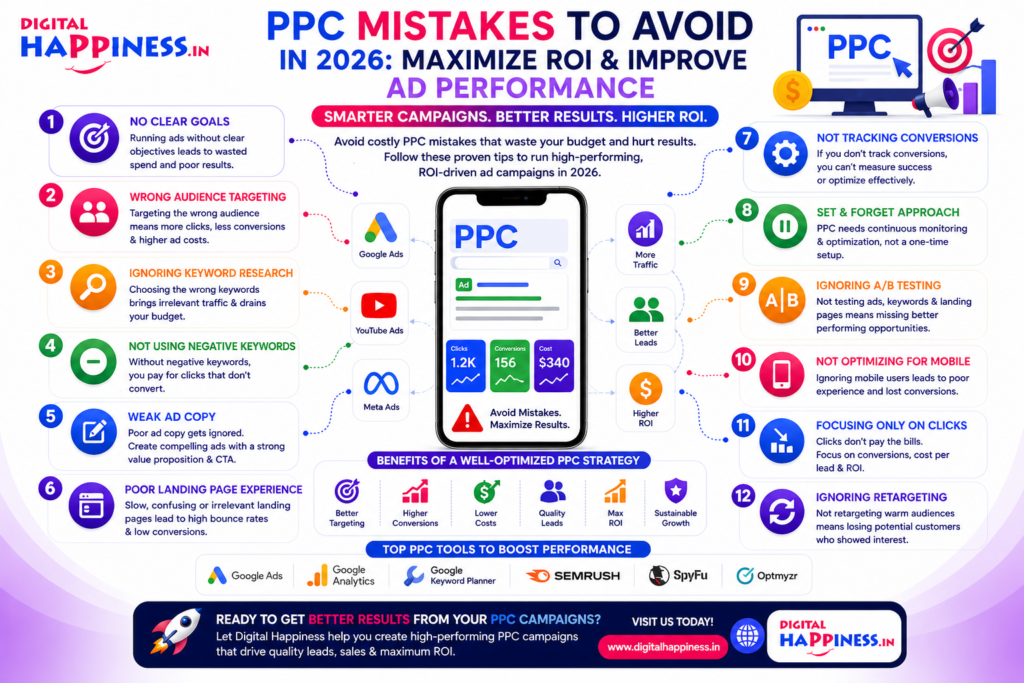
Pay-Per-Click (PPC) advertising remains one of the fastest and most effective ways to generate leads and sales online in 2026. Platforms like Google Ads, YouTube Ads, and Meta Ads allow businesses to reach highly targeted audiences and drive instant traffic.
However, many businesses fail to achieve good results from PPC campaigns—not because PPC doesn’t work, but because of avoidable mistakes.
Poor targeting, weak ad copy, and improper optimization can quickly waste your budget and reduce conversions. To succeed with paid advertising in 2026, businesses need a smart, data driven approach.
In this guide, we’ll explore the most common PPC mistakes businesses make and how to avoid them for better performance and higher ROI.
1. Not Defining Clear Campaign Goals
One of the biggest PPC mistakes is launching campaigns without clear objectives.
Before running ads, ask yourself:
- Do you want leads?
- Website traffic?
- Sales?
- Brand awareness?
Without clear goals, it becomes difficult to measure success and optimize performance.
A successful PPC strategy starts with setting measurable objectives.
2. Targeting the Wrong Audience
Audience targeting is critical for PPC success.
Many businesses waste money by targeting:
- Broad audiences
- Irrelevant locations
- Users with low buying intent
In 2026, advanced audience segmentation allows businesses to target users based on:
- Interests
- Search intent
- Behavior
- Demographics
The more precise your targeting, the better your results.
3. Ignoring Keyword Research
Keywords are the foundation of Google Ads campaigns.
Choosing the wrong keywords can lead to:
- High costs
- Low-quality traffic
- Poor conversions
To improve PPC performance:
- Use high intent keywords
- Focus on long tail keywords
- Analyze competitor keywords
For example:
Instead of targeting marketing, target affordable digital marketing services in India.
4. Not Using Negative Keywords
Negative keywords prevent your ads from showing for irrelevant searches.
Without negative keywords:
- You waste ad spend
- Attract unqualified traffic
- Reduce campaign efficiency
Example:
If you sell premium services, you may exclude searches containing free or cheap.
Negative keywords improve targeting and ROI.
5. Weak Ad Copy
Your ad copy directly affects clicks and conversions.
Common mistakes include:
- Generic messaging
- Lack of CTA
- No value proposition
Effective ads should:
- Grab attention
- Highlight benefits
- Include a strong CTA
Example CTAs:
- Get a Free Consultation
- Start Growing Today
- Boost Your Sales Now
6. Poor Landing Page Experience
Driving traffic is only half the battle. If your landing page is poorly optimized, users will leave without converting.
Common issues:
- Slow loading speed
- Confusing design
- Weak CTA
- Non-mobile-friendly pages
A high-converting landing page should:
- Match the ad message
- Be simple and clear
- Focus on one goal
7. Ignoring Mobile Optimization
In 2026, most PPC traffic comes from mobile devices.
If your ads or landing pages are not mobile-friendly:
- You lose conversions
- Bounce rates increase
- User experience suffers
Ensure:
- Fast loading pages
- Mobile responsive design
- Easy navigation
8. Not Tracking Conversions Properly
Many businesses focus only on clicks and impressions.
But clicks don’t always mean success.
You should track:
- Leads
- Sales
- Phone calls
- Form submissions
Conversion tracking helps you understand which campaigns generate actual business results.
9. Setting & Forgetting Campaigns
PPC campaigns require continuous optimization.
Common mistake:
Businesses launch ads and never update them.
Successful PPC management involves:
- Monitoring performance
- Testing ad variations
- Adjusting bids
- Improving targeting
Regular optimization leads to better ROI.
10. Ignoring A/B Testing
A/B testing compares different versions of ads to identify what performs best.
You can test:
- Headlines
- CTAs
- Images
- Landing pages
Even small improvements can significantly increase conversions.
11. Focusing Only on Clicks Instead of ROI
High clicks don’t always equal success.
The real goal is:
- Leads
- Sales
- Revenue
A successful PPC campaign focuses on return on investment (ROI), not just traffic.
12. Not Retargeting Potential Customers
Most users don’t convert on their first visit.
Retargeting helps bring them back by showing relevant ads after they leave your site.
Benefits of retargeting:
- Higher conversions
- Better brand recall
- Improved ROI
Retargeting is one of the most powerful PPC strategies in 2026.
Why Avoiding PPC Mistakes Matters
Avoiding these PPC mistakes helps you:
- Save money
- Increase conversions
- Improve campaign performance
- Generate better leads
A well optimized PPC campaign can become a major growth driver for your business.
How Digital Happiness Can Help
At Digital Happiness, we create data driven PPC strategies designed to maximize results.
Our services include:
- Google Ads management
- PPC optimization
- Keyword research
- Landing page optimization
- Conversion tracking
We help businesses generate quality leads and achieve better ROI through smart advertising strategies.
🚀 Conclusion
PPC advertising in 2026 offers massive opportunities for business growth, but only when managed correctly. Avoiding common mistakes like poor targeting, weak ad copy, and lack of optimization can dramatically improve your results.
With the right strategy, PPC can help your business attract high quality leads, increase conversions, and grow faster.
Ready to run high-performing PPC campaigns that drive real results?
👉 Visit https://digitalhappiness.in/ today and let Digital Happiness create a powerful PPC strategy tailored to your business goals.