
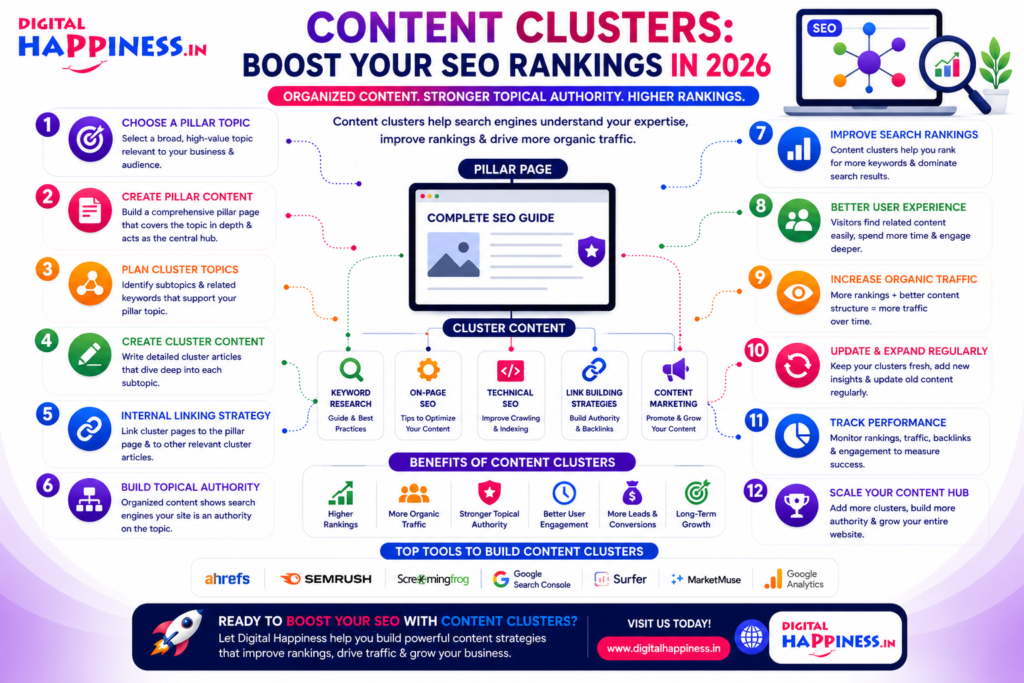
In 2026, SEO is no longer about publishing random blog posts and hoping they rank. Search engines now prioritize websites that demonstrate topical authority, relevance, and structured content organization. That’s where content clusters come in.
A smart content cluster strategy helps businesses improve rankings, increase organic traffic, and create a better user experience. Whether you run an eCommerce website, local business, or service-based company, implementing content clusters can transform your SEO performance.
At Digital Happiness, we help businesses create SEO-driven content strategies that generate traffic, leads, and long-term growth.
What Are Content Clusters?
Content clusters are a group of related articles connected around one main topic, also called a pillar page.
Instead of creating isolated blog posts, you organize content into categories that internally link to each other. This structure helps Google understand your expertise on a topic.
For example:
Pillar Topic:
SEO Services
Cluster Content:
- Local SEO Tips
- Technical SEO Guide
- On Page SEO Checklist
- Keyword Research Strategy
- Link Building Techniques
- SEO Friendly Blog Writing
Each blog links back to the main pillar page and to related articles within the cluster.
This creates a strong topical network that improves rankings and boosts user engagement.
Why Content Clusters Matter for SEO in 2026
Google’s algorithm has become smarter with AI powered search and semantic understanding. Search engines now evaluate how deeply your website covers a topic.
A proper content cluster strategy helps by:
- Improving keyword rankings
- Increasing website authority
- Boosting internal linking
- Reducing bounce rates
- Improving crawlability
- Enhancing user experience
- Increasing time spent on site
Businesses investing in structured content marketing are seeing stronger long term SEO results compared to websites publishing disconnected articles.
If you want sustainable growth, combining content clusters with professional <a href=”https://digitalhappiness.in/seo-services/”>SEO services</a> can significantly improve your online visibility.
How Content Clusters Work
A content cluster consists of three major elements:
1. Pillar Page
A pillar page is a comprehensive guide covering a broad topic.
Example:
- Complete SEO Guide for Beginners
- Ultimate PPC Advertising Guide
- Local SEO Strategy 2026
The pillar page targets high volume keywords and provides an overview of the entire topic.
2. Cluster Content
Cluster articles dive deeper into specific subtopics.
For example, if your pillar page is about Local SEO, cluster articles may include:
- Google Business Profile Optimization
- Local Keyword Research
- Citation Building
- Local Link Building
- Online Reviews Strategy
These blogs target long tail keywords and provide detailed insights.
You can explore advanced <a href=”https://digitalhappiness.in/local-seo-services/”>Local SEO strategies</a> to strengthen your business visibility in Google Maps and local searches.
3. Internal Linking
Internal linking connects all related articles.
This tells Google:
- Your content is related
- Your website covers the topic deeply
- Users can easily navigate the content
Strong internal linking also distributes page authority across your website.
Benefits of Content Clusters
Improved Keyword Rankings
Instead of ranking for just one keyword, content clusters help your website rank for multiple related search terms.
For example:
- content clusters
- SEO content strategy
- topical authority
- content hub strategy
- pillar page SEO
This increases your visibility across search engines.
Higher Organic Traffic
When your website ranks for multiple keywords, you naturally attract more traffic.
Cluster strategies help businesses generate:
- More blog traffic
- Better lead generation
- Higher search visibility
- Consistent organic growth
At Digital Happiness, we build SEO focused content strategies that help businesses increase organic traffic without relying entirely on paid ads.
Better User Experience
Visitors can easily navigate related content and find answers faster.
This:
- Improves engagement
- Reduces bounce rate
- Increases session duration
- Encourages conversions
Google values websites that provide helpful user experiences.
Stronger Topical Authority
Publishing multiple articles around one topic signals expertise to Google.
For example, a website with:
- SEO guides
- SEO tools
- SEO tutorials
- SEO case studies
- SEO optimization blogs
will likely rank higher than a site with only one SEO article.
How to Create an Effective Content Cluster Strategy
Step 1: Choose a Core Topic
Select a broad topic relevant to your business.
Examples:
- SEO
- PPC Advertising
- Social Media Marketing
- Website Design
- Email Marketing
The topic should have:
- High search demand
- Business relevance
- Multiple subtopics
Step 2: Perform Keyword Research
Find:
- Primary keywords
- Long-tail keywords
- Related questions
- Semantic keywords
Use tools like:
- Google Keyword Planner
- Ahrefs
- SEMrush
- Ubersuggest
For example:
Primary Keyword:
- Content clusters
Secondary Keywords:
- SEO content strategy
- pillar pages
- topical authority SEO
- internal linking SEO
Step 3: Create the Pillar Page
Write a comprehensive guide covering the main topic.
Your pillar page should:
- Be 2000+ words
- Cover major subtopics
- Include visuals
- Use structured headings
- Include internal links
Step 4: Create Supporting Cluster Content
Now create detailed blogs targeting specific subtopics.
Examples:
- How Internal Linking Improves SEO
- Best Content Marketing Strategies
- Keyword Research Guide
- Blog Writing Tips for SEO
If you want professionally optimized content, our <a href=”https://digitalhappiness.in/content-marketing-services/”>content marketing services</a> can help create SEO-friendly blogs designed to rank and convert.
Step 5: Build Strategic Internal Links
Link:
- Cluster blogs → pillar page
- Pillar page → cluster blogs
- Cluster blogs → related articles
Use descriptive anchor text instead of generic phrases like “click here.”
Example:
- “Learn more about <a href=”https://digitalhappiness.in/seo-services/”>SEO services</a>”
- “Improve rankings with <a href=”https://digitalhappiness.in/local-seo-services/”>local SEO optimization</a>”
Common Content Cluster Mistakes to Avoid
Creating Thin Content
Avoid writing shallow articles with little value.
Google rewards:
- Detailed guides
- Helpful information
- Unique insights
- Well-structured content
Ignoring Internal Linking
Without internal links, your content cluster loses effectiveness.
Every article should connect naturally to relevant pages.
Targeting Random Keywords
Your cluster content should support the pillar topic.
Avoid unrelated blog topics that confuse search engines.
Not Updating Old Content
SEO changes rapidly.
Regularly refresh:
- Statistics
- Keywords
- Internal links
- Examples
- Search intent
Updated content performs better in rankings.
Best Industries for Content Clusters
Content clusters work especially well for:
- Digital marketing agencies
- SaaS businesses
- eCommerce stores
- Healthcare websites
- Educational platforms
- Local businesses
- Finance websites
Any business wanting long-term SEO growth can benefit from structured content strategies.
The Future of SEO Content in 2026
AI-powered search engines are prioritizing:
- Expertise
- Content depth
- User intent
- Topic relevance
- Structured information
This means random blogging no longer works.
Businesses need:
- Strategic content planning
- Topic authority
- High-quality SEO content
- Strong internal linking
- Consistent publishing
Content clusters are becoming one of the most powerful SEO strategies for sustainable growth.
Final Thoughts
If you want higher rankings, better organic traffic, and stronger authority in 2026, content clusters should be a major part of your SEO strategy.
Instead of publishing disconnected blogs, focus on building organized topic hubs that provide real value to users.
A well-structured content cluster strategy can:
- Improve Google rankings
- Increase website traffic
- Build authority
- Generate leads
- Strengthen brand trust
Whether you’re a startup or an established business, investing in structured SEO content is essential for long-term online success.
Ready to Build SEO Content That Actually Ranks?
At Digital Happiness, we create powerful SEO content strategies designed to improve rankings, boost traffic, and grow your business organically.
Our services include:
- SEO Content Writing
- Content Cluster Strategy
- Keyword Research
- On-Page SEO
- Local SEO
- Technical SEO
- PPC & Digital Marketing
Visit Digital Happiness today and start building a smarter SEO strategy for 2026!