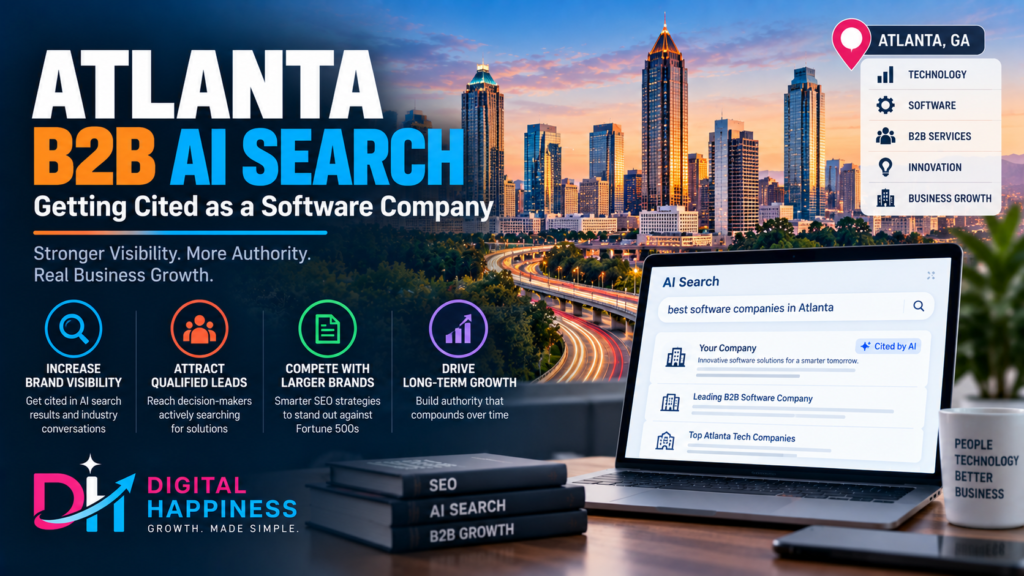
Why Atlanta B2B AI Search Visibility Is a Growing Priority
A significant and growing share of B2B software research now happens inside AI assistants — a buyer asking ChatGPT or Perplexity to compare vendors, summarize a category, or explain a technical concept before ever visiting a company’s site. For Atlanta software companies, competing in a market already dense with established fintech and SaaS players, showing up accurately in those AI-generated summaries is increasingly as important as traditional search rankings.
What Makes Content Genuinely Citable by AI Models
AI systems extract and cite content differently than a human skimming a page. Structuring content to be genuinely citable means:
- Self-contained paragraphs that answer one specific question completely, without requiring surrounding context
- Clear entity signals — product name, category, and key differentiators stated explicitly rather than implied
- Precise, verifiable technical claims rather than vague marketing language AI systems are trained to discount
Want this applied to your Atlanta business? Get a free audit showing exactly what’s holding your rankings back.
Get a Free Audit →Structured Comparison Content Performs Especially Well
When a buyer asks an AI assistant to compare vendor options, content already structured as a clear comparison — feature by feature, with specific differentiators named plainly — is far more likely to be accurately summarized than a page written as flowing marketing prose. This is one of the highest-leverage content types for GEO/AEO specifically, since it maps directly onto how buyers phrase comparison questions to AI tools.
How This Fits Alongside Traditional Atlanta SEO
None of this replaces conventional SEO fundamentals — technical performance, backlink authority, and keyword-aligned content still matter. GEO/AEO work is additive, applying the same underlying content to a second, fast-growing discovery channel. See our companion piece on B2B SaaS SEO strategy for Atlanta software companies for how the two strategies combine into one program.
Key Takeaways
- A growing share of B2B software research happens inside AI assistants before a buyer visits any company website.
- Citable content is self-contained, uses clear entity signals, and makes precise rather than vague claims.
- Structured comparison content is especially effective for AI citation, since it mirrors how buyers phrase comparison questions.
- GEO/AEO work is additive to traditional SEO, not a replacement for technical and content fundamentals.
Frequently Asked Questions
How do I know if my content is being cited by AI tools?
Some AI platforms surface citations directly; otherwise, periodically querying tools like ChatGPT or Perplexity with buyer-style questions about your category is a practical way to check whether and how your company gets mentioned.
Does GEO/AEO work require completely rewriting existing content?
Often no — many pages just need restructuring (clearer headers, more self-contained sections, explicit rather than implied claims) rather than a full rewrite.
Is Atlanta B2B AI search different from GEO/AEO elsewhere?
The underlying tactics are universal, but Atlanta’s dense, established fintech and SaaS competition make it more urgent to differentiate clearly, since AI systems are effectively summarizing an already crowded field.
Which AI platforms matter most for B2B software research?
ChatGPT, Perplexity, and Google’s AI Overviews currently account for the large majority of AI-assisted B2B research, making them the priority for most companies’ GEO/AEO efforts.