Still Burning Budget Without Knowing Why?
You launched Google Ads. Clicks rolled in. But sales? Barely moved. Or maybe you invested months into SEO, watched rankings crawl up, and questioned whether it was worth it.
This confusion is costing small and mid-size businesses thousands every month. The paid vs organic digital marketing debate is not just academic. It directly impacts your revenue, your team’s time, and your competitive edge.
Here is the truth: there is no universal winner. But there is a right answer for your business right now. This guide breaks down the SEO vs PPC strategy decision so you can stop guessing and start growing.
What Is the Real Difference Between Google Ads and SEO?
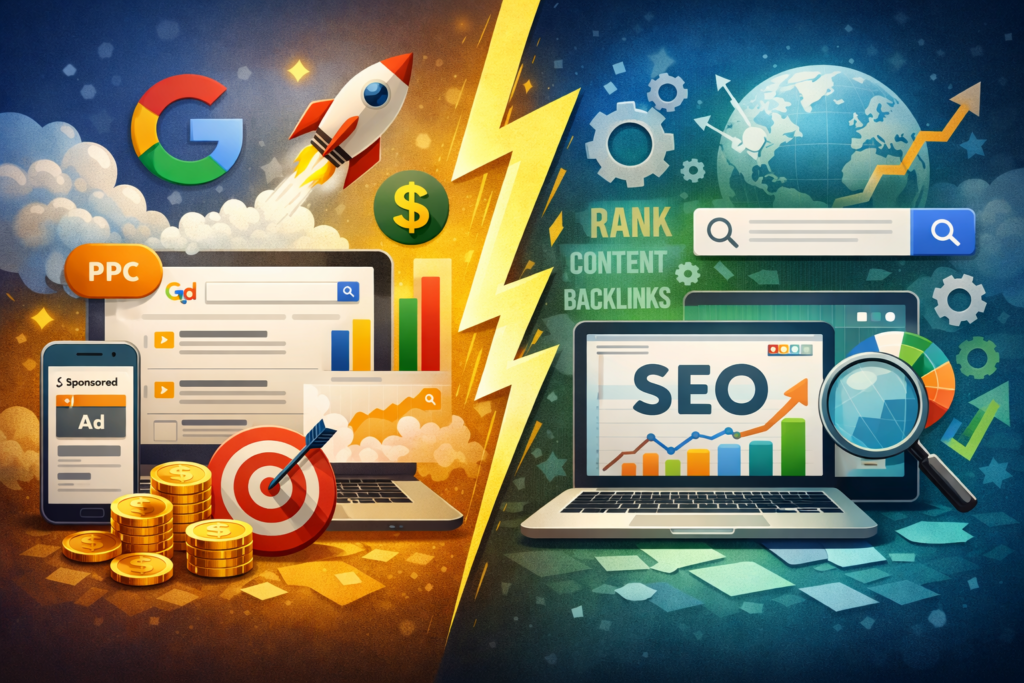
Google Ads (PPC) means you pay every time someone clicks your ad. Results are immediate. Visibility stops the moment your budget runs out.
SEO (Search Engine Optimization) means earning organic rankings through content, technical health, and backlinks. It takes time, but the traffic compounds over months and years.
Think of PPC as renting visibility and SEO as owning it. Both have a place in a smart Google Ads vs SEO 2026 strategy.
When Google Ads Is the Right Move
Speed and Immediacy Are Priorities
If you need leads this week, not this quarter, Google Ads wins. New product launches, seasonal promotions, and event-based campaigns demand speed.
- Use PPC when: You have a proven offer and just need volume fast
- Use PPC when: You are testing messaging or landing page copy
- Use PPC when: Your industry is highly competitive and ranking organically takes 12+ months
According to Word Stream, businesses make an average of $2 in revenue for every $1 spent on Google Ads when campaigns are well-managed.
When SEO Delivers Better Long-Term ROI
Compounding Value Over Time
SEO builds an asset. A blog post ranking on page one can bring traffic for years without additional spend. That is the compounding power of organic search.
- Use SEO when: You are playing a long game and want sustainable traffic
- Use SEO when: Your audience researches before buying (high-intent informational queries)
- Use SEO when: You want to reduce customer acquisition cost over time
HubSpot reports that inbound leads from SEO cost 61% less than outbound leads. Over 12 to 24 months, the ROI gap widens significantly.
The Paid vs Organic Digital Marketing Trap to Avoid
The biggest mistake SMBs make is treating this as an either-or choice. In reality, paid and organic work best together.
Running Google Ads while ignoring SEO means you will always be at the mercy of rising CPCs. Running only SEO means slow growth during your most critical early months.
- Use PPC data to identify which keywords convert, then double down with SEO content
- Use SEO rankings to reduce ad spend on terms where you already rank organically
- Build retargeting audiences through paid traffic, then nurture with organic content
Key Takeaway: The smartest businesses use paid to accelerate and organic to sustain.
Budget Reality: What You Actually Need to Invest
Google Ads Budget Benchmarks
Most SMBs need a minimum of $1,500 to $3,000 per month in ad spend to generate meaningful data. Below that, the algorithm has insufficient data to optimize.
- Include management fees: budget 15 to 20% extra for agency or tool costs
- Factor in landing page optimization, often an overlooked line item
- Expect 60 to 90 days to see optimized performance
SEO Investment Timeline
A realistic SEO engagement for an SMB starts at $1,000 to $2,500 per month for content creation, technical fixes, and link building.
- Expect 3 to 6 months before meaningful traffic gains
- Month 6 to 12 is typically when the ROI starts to exceed paid channel returns
- Content created today continues working for years
SEO vs PPC Strategy: A Side-by-Side Comparison
Speed: PPC delivers results in days. SEO takes 3 to 12 months.
Cost: PPC requires ongoing spend. SEO has higher upfront effort but lower long-term cost per lead.
Sustainability: PPC traffic stops when budget stops. SEO traffic compounds.
Targeting: PPC allows hyper-precise audience and keyword targeting. SEO captures intent-based organic searchers.
Trust: 70% of searchers click organic results over paid ads, per Advanced Web Ranking data.
Common Pitfalls to Avoid in 2026
- Ignoring Quality Score in Google Ads: Low Quality Scores inflate your CPC dramatically. Always align ad copy with landing page content.
- Skipping Technical SEO: Fast rankings require a crawlable, fast-loading, mobile-optimized site. Content alone is not enough.
- Not tracking conversions properly: Both channels need accurate attribution. Without proper tracking, you are optimizing blindly.
- Choosing based on trend, not data: What works in one industry may fail in another. Base your decision on your specific CPC, competition, and buying cycle.
How to Decide: A Simple Framework
Answer these three questions to guide your Google Ads vs SEO 2026 decision:
- 1. How quickly do you need results? If within 90 days, start with PPC.
- 2. What is your customer lifetime value? High LTV justifies higher SEO investment.
- 3. How competitive is organic search in your niche? High competition means you may need PPC to compete while SEO matures.
Most SMBs benefit from a 70/30 or 60/40 split: heavier on the channel that matches their current growth phase, lighter on the other for data and diversification.
Conclusion: Stop Choosing Sides, Start Building a System
The paid vs organic digital marketing debate ends when you stop seeing them as competitors and start treating them as partners.
PPC wins on speed. SEO wins on sustainability. Together, they win on growth.
Your next step is simple: audit where your business is today. If you have no traffic, start with PPC. If you have traffic but no conversions, fix your SEO foundation. If you have both, integrate them.
Ready to build a strategy that actually drives ROI? Book a free 30-minute growth audit with our team today and get a custom channel recommendation for your business.