
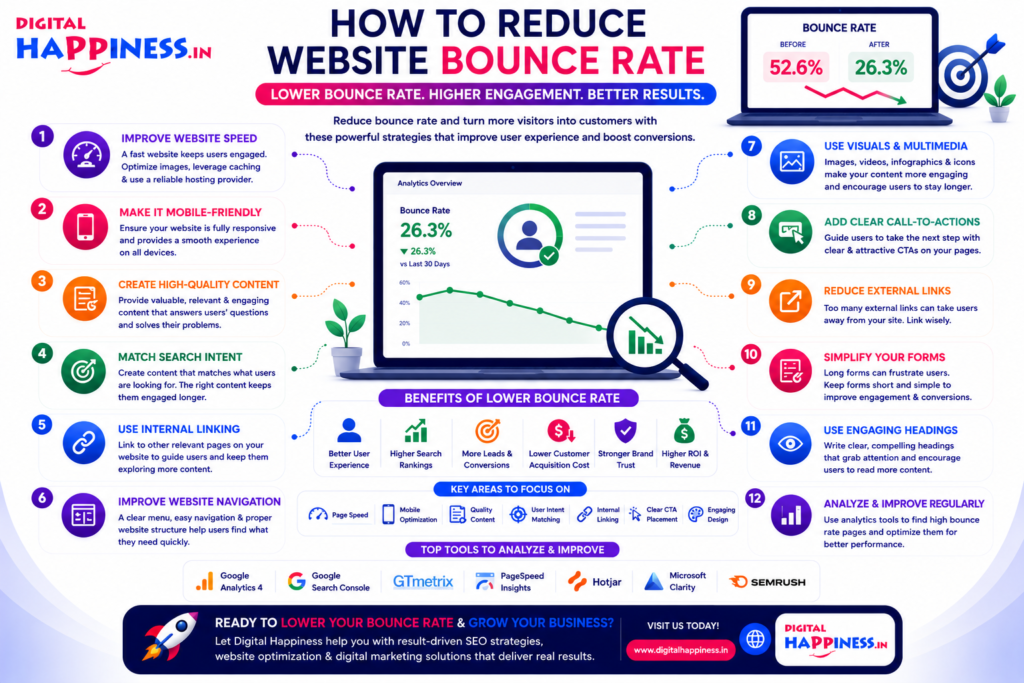
You spent months building a beautiful website, investing in ads, and crafting content — only to watch visitors leave within seconds. Sound familiar? A high bounce rate is one of the most frustrating challenges for any website owner. The good news? It’s entirely fixable.
In this guide, the team at Digital Happiness walks you through proven, actionable strategies to reduce bounce rate, increase engagement, and turn fleeting visitors into loyal customers.
55%
of visitors leave within 15 seconds
40%
abandon pages that load in >3 seconds
74%
return to mobile-unfriendly sites
What Exactly Is Bounce Rate?
Bounce rate is the percentage of visitors who land on your website and leave without interacting with any other page. Google Analytics defines it simply: one page view, zero further actions. A bounce rate between 26–40% is considered excellent; 70%+ signals trouble.
But here’s the nuance, not all bounces are bad. A visitor who reads your entire blog post and leaves satisfied has technically “bounced.” Context matters. What you want to eliminate are disengaged bounces, where visitors leave because they’re confused, frustrated, or underwhelmed.
Pro Tip: Use Google Analytics 4’s Engagement Rate alongside Bounce Rate for a more accurate picture of how users actually interact with your site.
1. Slash Your Page Load Time
Speed is everything. Research consistently shows that a 1-second delay in page load time can reduce conversions by 7%. If your site is slow, visitors won’t wait, they’ll hit the back button and choose a competitor instead.
- Compress and serve images in next-gen formats (WebP, AVIF)
- Enable browser caching and use a CDN (Content Delivery Network)
- Minimize JavaScript and CSS files
- Upgrade to a reliable hosting provider
- Use lazy loading for images and videos below the fold
Tools like Google PageSpeed Insights and GTmetrix give you a free performance audit with specific recommendations. Our website optimization services at Digital Happiness can get your site scoring 90+ with ease.
2. Make a Strong First Impression Above the Fold
You have roughly 8 seconds to convince a visitor to stay. The “above the fold” area — what users see without scrolling needs to communicate your value proposition instantly. A powerful headline, a compelling subheading, and a clear CTA (call-to-action) are non negotiable.
Ask yourself: Can a stranger understand what your site offers within 5 seconds? If the answer is no, your hero section needs a redesign. Our UI/UX design team specializes in creating first impressions that stick.
3. Improve Mobile Responsiveness
Over 60% of all web traffic comes from mobile devices. If your website isn’t fully optimized for smartphones and tablets, you’re losing more than half your audience before they’ve even read a single line of content.
- Use a responsive design framework (Bootstrap, Tailwind CSS)
- Test across multiple screen sizes using Chrome DevTools
- Ensure buttons and tap targets are at least 44×44 pixels
- Eliminate horizontal scrolling and tiny unreadable fonts
Quick Win: Run Google’s free Mobile-Friendly Test on your URL — it shows exactly what mobile users experience and where your site breaks.
4. Align Content with Search Intent
One of the biggest (and most overlooked) causes of high bounce rates is a mismatch between what users expect and what your page delivers. If someone searches for best digital marketing tips and lands on a sales page, they’ll leave immediately.
Study the keywords driving traffic to each page and ensure your content genuinely satisfies that intent, whether it’s informational, navigational, or transactional. This is a core pillar of our SEO strategy services at Digital Happiness.
5. Enhance Readability and Content Quality
Even great information drives people away if it’s poorly presented. Walls of text, tiny fonts, and poor contrast are readability killers. Follow these guidelines:
- Use short paragraphs (2–4 sentences max)
- Break content with subheadings, bullet points, and visuals
- Choose a minimum body font size of 16px
- Maintain strong contrast between text and background
- Use images, infographics, or videos to support key points
Remember — online readers scan before they read. Structure your content to reward both behaviors.
6. Use Internal Links Strategically
Every page on your site should offer visitors somewhere interesting to go next. Strategic internal linking keeps users exploring, boosts your SEO, and dramatically reduces bounce rates by creating a logical content journey.
Don’t just link randomly, connect related articles, service pages, and resources that genuinely add value for the reader. This creates a web of content that keeps visitors engaged for longer.
7. Add Engaging Multimedia and Interactive Elements
Multimedia content dramatically increases time on page. Embedding an explainer video, interactive quiz, or product demo gives visitors a reason to stay and come back. Even simple elements like image carousels, accordions, or comparison tables can boost engagement significantly.
If your pages are purely text heavy, consider how a short embedded video or an interactive tool could transform the user experience. Our content marketing team creates multimedia assets that convert visitors into leads.
8. Optimize Your CTAs and Pop-Ups
Poorly timed or aggressively placed pop-ups are a major bounce trigger. If a pop-up fires the moment a user lands on your page, they’ll leave guaranteed. Instead, use exit-intent pop-ups, scroll-triggered offers (after 50% of the page), or time-delayed prompts (after 30 seconds).
Every page should also have a clear, relevant CTA that guides the visitor to their next logical step. Confused visitors bounce; guided visitors convert.
9. Build Trust Signals Throughout Your Site
Visitors bounce when they don’t trust a site. Add credibility elements across every important page:
- Client testimonials and star ratings
- Case studies and measurable results
- Logos of brands you’ve worked with
- Security badges and SSL certificate indicators
- Clear contact information and a real About Us story
Trust is the invisible glue that holds visitors on your site.
10. Analyze, Test, and Iterate
Reducing bounce rate isn’t a one-time fix, it’s an ongoing process. Use tools like Google Analytics 4, Hotjar (heatmaps and session recordings), and A/B testing platforms to continuously understand how users behave and where they drop off. Test different headlines, layouts, CTAs, and imagery.
Data-driven conversion rate optimization (CRO) is how the best digital brands stay ahead of the curve.
Final Thoughts: Reducing your website’s bounce rate comes down to one fundamental principle, respect your visitor’s time. Give them fast load speeds, relevant content, intuitive navigation, and a reason to stay. Implement even half the strategies in this guide and you’ll see measurable improvements within weeks.
Ready to Stop Losing Visitors?
Let the experts at Digital Happiness audit your website, identify what’s causing your bounce rate spike, and build a tailored strategy to fix it — fast. Get a Free Website Audit ↗Or explore our digital marketing services →
Digital Happiness Team
Full-service digital marketing agency helping brands grow online through SEO, web design, content strategy, and conversion optimization.