
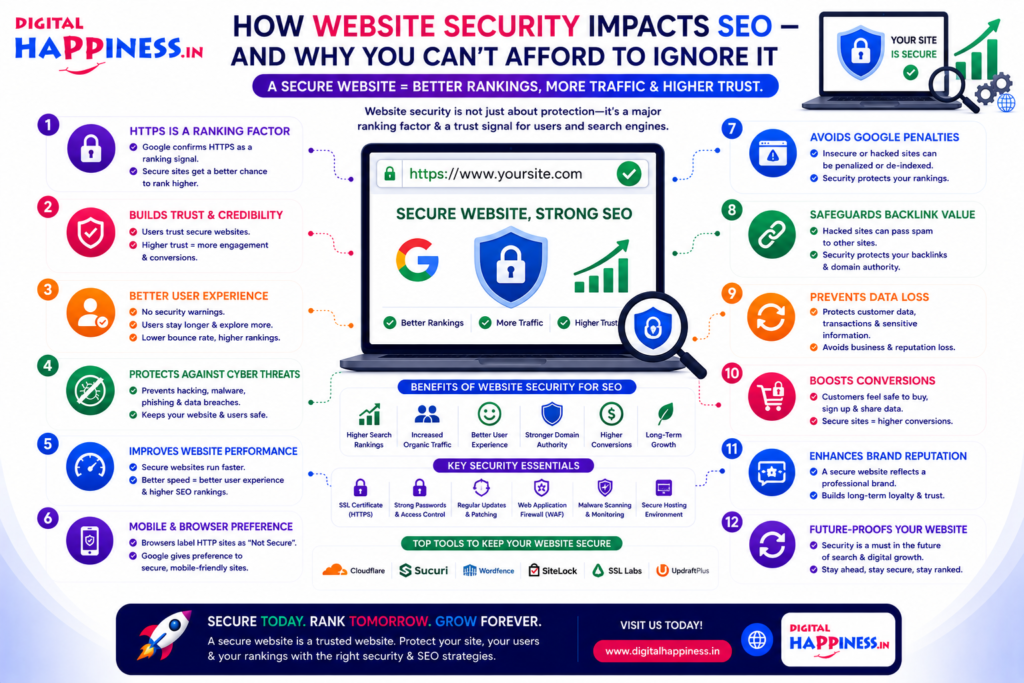
Your website can have the best content, the fastest load times, and a beautifully optimised structure — but if it’s not secure, Google won’t rank it. Website security and SEO are no longer separate disciplines. They are two sides of the same coin.
In today’s digital landscape, search engines don’t just reward great content — they reward trustworthy, safe, and technically sound websites. Whether you run an e-commerce store, a service business, or a personal brand, understanding how website security directly affects your SEO performance is critical to staying ahead of the competition.
At Digital Happiness, we work with businesses across India and globally to build secure, high-ranking digital presences. This blog breaks down exactly why security is an SEO priority — and what you should be doing about it right now.
🔒HTTPS is a confirmed Google ranking signal since 2014
85%of users abandon a site marked “Not Secure” by browsers
5×faster recovery from penalties with a clean security record
30%higher engagement on HTTPS sites vs HTTP counterparts
1. HTTPS is a Google Ranking Factor
Back in 2014, Google officially announced that HTTPS is a ranking signal. This means websites that use SSL/TLS certificates — encrypting data between a browser and a server — receive a measurable boost in search rankings over unsecured HTTP sites.
If your website still runs on HTTP, you’re not just exposing your visitors to risk — you’re actively telling Google’s algorithm that your site is less trustworthy than your competitors. Modern SEO optimisation strategies always begin with ensuring your site runs on a verified SSL certificate. This is non-negotiable.
2. Browser Warnings Kill Your Traffic (And Rankings)
Google Chrome, Firefox, and other browsers now display a prominent “Not Secure” warning for any page without HTTPS. The moment a visitor sees this warning, bounce rates spike. And when users bounce immediately, it sends a negative signal to Google — telling it that your page doesn’t satisfy user intent.
High bounce rates and low dwell time are indirect ranking factors. A security warning is essentially a wall between your business and your audience. A robust technical SEO audit will catch these issues before they cost you rankings and revenue.
3. Malware, Blacklisting, and Search Engine Penalties
If your website gets hacked and malware is injected into your pages, Google’s Safe Browsing system will detect it — and your site will be blacklisted. A blacklisted site is removed from search results entirely, or shown with a severe warning that scares away users.
Recovering from a Google blacklist is one of the most painful and time-consuming SEO challenges. It involves cleaning the malware, submitting a reconsideration request, and waiting — sometimes weeks — for Google to review your site. The damage to organic traffic, brand trust, and revenue during this period is significant.
Proactive website security monitoring and regular vulnerability scans are the best way to avoid ever reaching this point.
4. Site Speed, Uptime, and Server Security
Website security also affects site performance. DDoS (Distributed Denial of Service) attacks, brute-force login attempts, and bot traffic can overload your server, causing slow load times or outright downtime. Google’s Core Web Vitals — including Largest Contentful Paint (LCP) and Time to First Byte (TTFB) — are direct ranking signals tied to how fast your pages load.
A compromised or unprotected server can result in:
Security issues that hurt SEO performance
- Slower page load speeds due to bot traffic and injected scripts
- Server downtime causing Googlebot to fail crawling your site
- Spam links or hidden content injected by hackers, triggering penalties
- Redirects to malicious external sites, destroying your domain authority
Working with an agency that understands both technical SEO and infrastructure security means you’re protected from all of these angles simultaneously.
5. Googlebot Trust and Crawl Integrity
Google’s crawler, Googlebot, needs to access your site regularly to index your pages. If your site has been compromised — with spam pages created, robots.txt modified, or sitemaps hijacked — Googlebot may index content you never intended to publish. This can result in keyword cannibalisation, duplicate content issues, or outright ranking drops for your core pages.
Maintaining a clean, secure site with a reliable XML sitemap and properly configured robots.txt ensures that Googlebot only sees what you want it to see. This directly supports better crawl efficiency and page indexation — both key pillars of strong AI-powered SEO strategies.
6. Local SEO and Trust Signals
For businesses targeting local markets, website security plays a critical role in building the trust signals that Google looks for. A secure site paired with consistent NAP (Name, Address, Phone) data, genuine reviews, and locally relevant content creates a powerful foundation for local SEO.
Users searching locally are often high-intent buyers. If your site triggers a security warning at the moment they’re ready to contact you or make a purchase, you’ve lost a conversion that your competitor will win. Security isn’t just an SEO issue — it’s a revenue issue.
7. E-E-A-T and Website Security
Google’s quality evaluator guidelines emphasise Experience, Expertise, Authoritativeness, and Trustworthiness (E-E-A-T). Trustworthiness is directly impacted by your website’s security posture. A site without HTTPS, with outdated plugins, or with a history of being flagged will score poorly on the trust dimension — even if the content itself is excellent.
Implementing strong security practices — SSL certificates, content security policies, regular backups, and malware scanning — signals to both Google and your users that you are a credible, trustworthy digital presence. This is increasingly important as Google leans on E-E-A-T signals in its evolving AI SEO ranking systems.
Website security checklist for better SEO
- Install and renew an SSL certificate — ensure your site runs on HTTPS
- Use a Web Application Firewall (WAF) to block malicious traffic
- Keep CMS, plugins, and themes updated to patch known vulnerabilities
- Schedule regular malware scans and automated security audits
- Set up Google Search Console to receive security issue alerts instantly
- Implement strong password policies and two-factor authentication on admin accounts
- Monitor backlinks regularly to catch negative SEO attacks early
The Bottom Line: Security Is SEO
Website security is no longer something you can defer or treat as a back-office concern. It is woven into every layer of how Google evaluates, ranks, and presents your website to users. From your HTTPS certificate to your server uptime, from your crawl integrity to your E-E-A-T score — security decisions directly shape your search rankings.
The brands that win online in 2025 and beyond are those that treat security as an ongoing investment, not a one-time setup. Combined with a strong SEO strategy, local SEO, and AI-powered SEO services, a secure website becomes an unstoppable growth engine.
Is Your Website Secure Enough to Rank?
Get a free SEO and security audit from Digital Happiness. We’ll identify what’s holding your rankings back — and exactly how to fix it.