
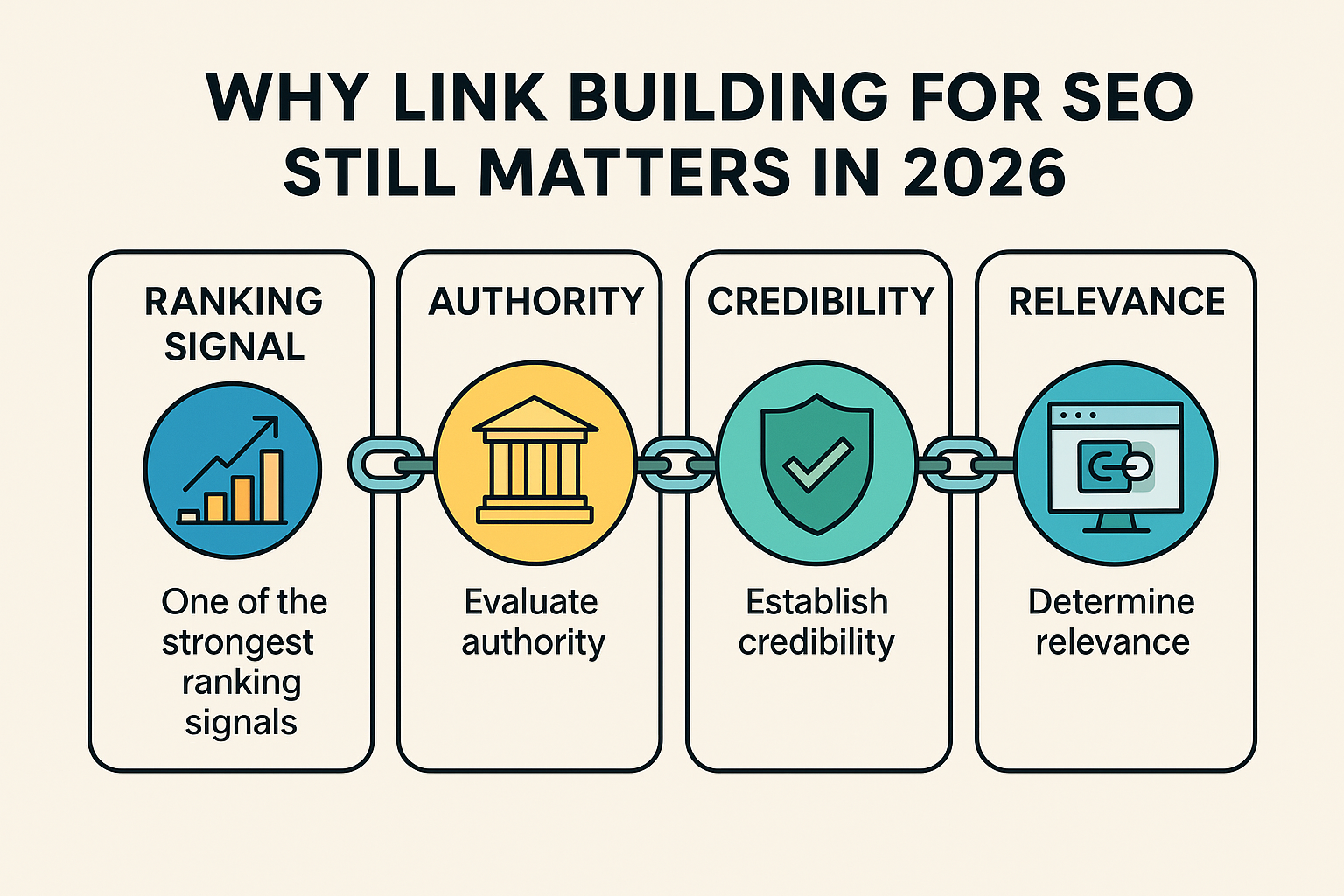
 If you’ve been in SEO long enough, you know the cycle: a tactic works brilliantly, everyone piles on, Google notices, and then the hammer falls. Link building has lived through more of these cycles than almost any other discipline – and 2026 is no different.
But here’s the thing: the fundamentals haven’t changed. High-quality backlinks from authoritative, topically relevant sites still move the needle. What’s changed is how you earn them, how Google evaluates them, and which shortcuts have become traps. This guide cuts through the noise.
“In 2026, a single link from a genuinely relevant authority is worth more than a hundred from directories no one reads.”
68%of top-ranking pages have 3x more backlinks than pages in positions 2–10
91%of all web pages get zero organic traffic – largely due to weak link profiles
4.4×more traffic earned by pages with strong editorial backlink profiles vs. those without
The 2026 Landscape
Why Link Building Got Harder – and More Valuable
Google’s Helpful Content Updates and the continued rollout of AI Overviews have reshaped how authority is measured. Links are no longer just votes – they’re signals of genuine editorial endorsement. An algorithm that can assess whether a backlink makes contextual, editorial sense is now in place, and it’s sophisticated enough to distinguish earned coverage from manufactured footprints.
The result? Spam is dying faster than ever, and legitimate link building is more powerful than it has been in years. The bar to earn links has risen, but the reward for clearing it is substantial.
At Digital Happiness, we’ve studied the link profiles of high-performing pages across industries – and the patterns are clear. Let’s break them down.
What Works
Link Building Strategies That Still Work in 2026
Digital PR & Data-Led Campaigns
Original research, proprietary data, and newsworthy insights earn editorial links from major publications. This is the gold standard in 2026.
Authentic Guest Posting
Writing genuinely useful content for respected publications in your niche still works – when the placement is editorially vetted and topically tight.
Broken Link Building
Find dead pages on authoritative sites, recreate the resource better than the original, and reach out. This tactic provides clear value to webmasters.
Skyscraper & HARO-Style Outreach
Becoming the best available resource on a topic and pitching it to journalists and bloggers who link to inferior content. AI-assisted or not, this earns links.
1. Digital PR: The Highest-ROI Link Building in 2026
Digital PR isn’t new – but it’s never been more effective. When your brand publishes original research, a compelling data story, or a tool that journalists genuinely want to write about, you earn contextual editorial links from sources with Domain Authority that money simply cannot buy.
The key is newsworthy specificity. Generic “State of X” reports won’t cut through. But a study on, say, how AI adoption has changed hiring patterns in your specific sector – with real numbers – will. Publications cite specific, surprising data. Give them that, and the links follow.
2. Niche-Relevant Guest Posting
Google has not killed guest posting. It has killed indiscriminate guest posting. Writing a genuinely expert piece for a respected industry publication is still one of the cleanest ways to build topical authority. The test: would the site publish this article from someone else, even if it didn’t link to you? If the answer is yes, you’re probably in the right territory.
3. Broken Link Building at Scale
With the web aging and sites going dark constantly, broken link opportunities are abundant. Tools like Ahrefs and Semrush make it straightforward to find broken pages on high-authority sites. Create the replacement content, then reach out. Webmasters are genuinely grateful – which means higher response rates than cold outreach.
4. Resource Page Link Building
Many universities, non-profits, and industry bodies maintain curated resource pages. If your content is genuinely the best available reference on a topic, requesting inclusion is a legitimate and often successful strategy. These links tend to be highly stable and carry strong authority signals.
5. Link Reclamation
Before you spend resources acquiring new links, audit what you’ve already earned. Brand mentions without links, broken backlinks pointing to 404 pages, and links to outdated content that’s been redirected – all of these represent quick wins. Reclamation often delivers the highest ROI of any link-building activity.
Podcast Appearances & Thought Leadership
Being a guest on podcasts in your industry frequently results in editorial links from show notes. These are genuine, contextual, and often from sites with strong topical authority.
Tool & Widget-Based Link Building
Creating genuinely useful free tools – calculators, generators, templates – that other sites embed or link to. The best tools earn hundreds of passive backlinks over years.
Strategic Internal Linking
While not a backlink, a robust internal linking structure amplifies the value of every external link you earn. This is often the most underused lever in link building strategy.
Link Building Tactics to Avoid in 2026
Private Blog Networks (PBNs)
Google’s ability to identify PBN footprints has reached a level where even well-maintained networks are regularly deindexed. The risk-reward ratio is now catastrophically negative.
Paid Links Without Disclosure
Undisclosed paid links violate Google’s guidelines. With improved link graph analysis, patterns of paid link schemes are increasingly detectable and penalised.
Low-Quality Directory Submissions
Generic, untopical directory links haven’t moved rankings in years. They now carry a mild negative signal – waste of resource at best, liability at worst.
Spammy Comment & Forum Links
Auto-generated comment spam and forum profile links are immediately discounted or flagged as manipulative. These tactics from 2010 have no place in 2026.
- Link exchanges: Direct A-B link swaps are flagged. Three-way exchanges are becoming detectable. Avoid.
- Mass anchor text manipulation: Unnatural anchor text ratios (all exact-match keywords) trigger over-optimisation penalties.
- AI-generated guest posts on irrelevant sites: Bulk AI content published across low-quality sites for link purposes is now a significant risk vector.
- DO diversify your anchor text: Mix branded, generic (“click here”), partial-match, and long-tail anchors for a natural-looking profile.
- DO prioritise topical relevance over raw authority: A DR 40 link from a directly relevant site often outperforms a DR 80 link from an irrelevant one.
- DO build links gradually: Sudden, unnatural spikes in link acquisition are a red flag. Sustained, consistent link earning is the safest growth pattern.
The Strategic Framework
The Digital Happiness Framework for Link Building in 2026
Effective link building in 2026 isn’t a list of tactics – it’s a system. Here’s how we approach it for our clients at Digital Happiness:
Step 1 – Audit before you build. Understand your current link profile. Know your topical authority, your anchor text distribution, and your most linked-to pages. This tells you where you have leverage and where you have gaps.
Step 2 – Set your content foundation. No link-building strategy works without content worth linking to. Invest in creating genuine assets – original research, comprehensive guides, tools, or insights that have clear standalone value. As Search Engine Land has consistently noted, content quality and link acquisition are inseparable in the modern search landscape.
Step 3 – Build a prospecting system. Identify the media, blogs, directories, and publications where your target audience actually engages. These are your priority link targets – not the highest DA sites, but the most relevant ones.
Step 4 – Execute outreach at human scale. Personalised, value-forward outreach. No templates. No spray-and-pray. The response rates on genuinely tailored outreach in 2026 are dramatically higher than mass automation.
Step 5 – Measure, monitor, and iterate. Track referring domain growth, anchor text evolution, and the downstream impact on rankings and traffic. Link building is a long game – optimise quarterly, not weekly.
“The SEOs winning in 2026 aren’t the ones building the most links – they’re the ones building the most trust.”
Final Thoughts
Link building remains one of the most powerful levers in SEO – and one of the most misunderstood. The tactics that work are less glamorous than the hacks that don’t: create exceptional content, earn genuine coverage, build relationships with the people in your industry who influence what gets linked to. Repeat consistently over time.
The sites ranking at the top in 2026 are not there by accident, and they’re not there because they found a shortcut. They’re there because they’ve built genuine authority through content and links that a real audience – and Google – actually values.
If you want to build a link profile that drives sustainable growth, the team at Digital Happiness is ready to help you do exactly that.
Free Strategy Session
Ready to Build Links
That Actually Rank?
Our team of SEO specialists builds authoritative, penalty-proof backlink profiles that drive lasting organic growth. Let’s analyse your current link profile – for free.