
SEO results timeline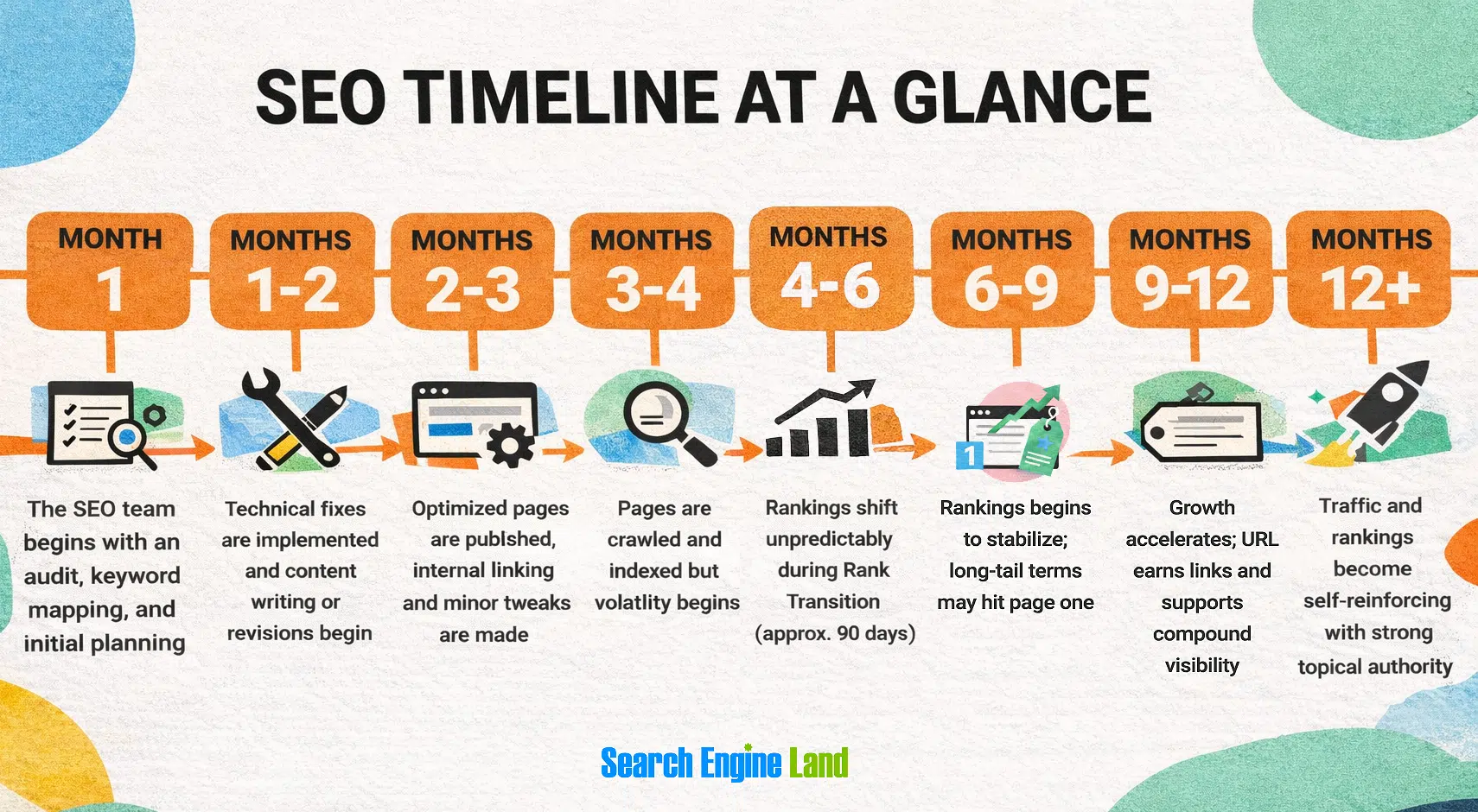
The honest, no-fluff answer to the question every client asks on Day 1 backed by data, Google’s own statements, and real campaign timelines.Quick answer: Most websites begin to see measurable movement on the SEO results timeline within 3–6 months but meaningful, revenue-driving growth typically takes 6–12 months of consistent work. Here is exactly what to expect, month by month.
If you have ever hired an SEO agency and asked “when will I see results?”, you have probably received a vague, hand-wavy answer. At Digital Happiness, we believe in radical transparency. This guide breaks down the exact SEO time you need, why the engine works the way it does, and what a results-driven SEO strategy looks like across a full year.
Why Does-SEO Result Take Time at All?
Before diving into the SEO result timeline, it is worth understanding the mechanism. Search engines are not instant approval machines. They are trust systems built to reward websites that demonstrate consistent authority, relevance, and usefulness over time.
As Search Engine Land explains, Google deliberately slows its response to SEO changes. If ranking were instant, spammy websites could game their way to the top overnight. The lag is a feature, not a bug it protects you from competitors who try to shortcut the system.Google’s own Search Advocate, John Mueller, has consistently reinforced this. He noted that a website starting out from virtually zero optimization and then implementing best practices could see a nice big jump in the beginning but sustainable growth after that follows a slower, compounding curve.
The Search Engine Journal breaks this further some changes like fixing a critical technical error can show ranking impact within days, while strategic content authority can take 6–12 months to fully compound.
- 3–6months for first: measurable results
- 6–12months for meaningful:traffic and leads
- 12+months for full:compounding grow
The Month-by-Month-SEO Results Timeline
Here is a realistic look at what a well-executed, SEO result timeline campaign delivers at each stage. This is based on patterns observed across hundreds of real campaigns not best-case scenarios.
Month 1: Technical Audit, Keyword Research & Setup-SEO Results
No visible ranking changes yet and that is completely normal. This month is about building the infrastructure that makes everything else work. Technical issues are diagnosed, keyword clusters are mapped to pages, Google Search Console is configured, and the content strategy is drafted. Think of this as pouring the foundation of a building invisible, but everything stands on it.
Months 2–3: Crawling, Indexing & First Keyword Movements-SEO Results
Google begins crawling and re-evaluating your updated pages. You will likely see impressions rising in Search Console your pages are showing up in search, even if not yet generating clicks at volume. One or two long-tail keywords may begin driving small but real organic traffic. Technical fixes made in Month 1 may produce quick wins for previously suppressed pages. This is the stage where momentum quietly builds.
Months 4–6: Rankings Stabilize, Traffic Grows-SEO Results
This is where the SEO results timeline becomes visible to everyone including your stakeholders. Rankings for target keywords stabilize in positions 5–20. Organic traffic begins a consistent upward trend. For many clients, Month 6 is the first time the channel starts generating qualified leads. According to Ahrefs data cited by Mangools, most websites see noticeable SEO results somewhere in this 3–6 month window.
Months 7–12: Authority Compounds, ROI Becomes Clear-SEO Results
The “Critical Authority Threshold” kicks in. Your backlink profile is maturing, topical authority is recognized by Google, and pages that ranked at position 8 are now pushing toward positions 1–3. Traffic growth accelerates without proportional increases in spend. This is the stage where SEO clearly outperforms PPC on a cost-per-lead basis and the gap widens every month.
Factors That Directly Impact Your-SEO Results
Not all websites move at the same pace. These are the variables that either accelerate or delay your SEO results timeline.
1.Domain Age & Authority
An established domain with a clean history moves faster than a brand-new site. New sites often face the Google Sandbox effect for the first 3–6 months.
2.Competition in Your Niche
A local service business can rank in 3 months. A national e-commerce store in a crowded category may need 12+ months to break into the top 10.
3.Backlink Profile Quality
High-quality editorial backlinks from relevant websites remain one of the strongest trust signals. Building these takes time, but significantly compresses the timeline.
4.Content Quality & Frequency
One exceptional piece of content per month outperforms four mediocre ones every week. Google rewards depth, originality, and genuine helpfulness over volume.
5.Technical SEO Health
A site with slow load times, crawl errors, or duplicate content gives Google reasons not to rank it. A technically clean site accelerates every other effort.
6.Implementation Speed
Recommendations that sit unimplemented for weeks delay results. The faster your team acts on SEO changes, the faster Google can process and reward them.
New Website vs. Established Website: How the-SEO Result Timeline Differs
One of the most important distinctions in understanding how long for SEO to work is the age and history of your domain.
| Factor | New Website (0–12 months old) | Established Website (2+ years) |
|---|---|---|
| Google Trust Level | Building from zero | Existing trust baseline |
| First visible results | 4–8 months typically | 2–4 months typically |
| Quick wins possible? | Limited – technical fixes only | Yes -on-page improvements |
| Sandbox risk | High – common for new domains | Low – past history protects |
| Revenue timeline | Typically 9–12 months | Typically 4–6 months |
What Driven-SEO Results Actually Looks Like
The phrase results-driven SEO gets thrown around a lot. At Digital Happiness, it means three specific things in practice:
- Transparent progress reporting -You should never be told wait and see. A good SEO partner provides clear data on impressions, rankings, crawl health, and link acquisition at every stage – not just when results are obvious.
- Intent-matched content strategy – Every piece of content is mapped to a specific keyword cluster and user intent. We do not create content for content’s sake; we create content that answers the exact questions your ideal customers are searching for.
- Compounding asset building – Unlike paid ads that stop the moment you stop spending, results-driven SEO builds assets that grow in value over time. A well-optimized blog post from Year 1 can still drive leads in Year 4.
- Technical foundations first – Fancy content on a technically broken website is like a billboard in a tunnel. Crawlability, page speed, Core Web Vitals, and schema markup are non-negotiable starting points.
- Local SEO integration where applicable -For businesses targeting specific cities or regions, local SEO can produce faster results and is often an underused competitive advantage.
Can You Speed Up the-SEO Results Timeline?
Within ethical bounds, yes – there are strategies that genuinely compress the timeline.
1.Topical authority clustering-SEO Results
Rather than publishing one-off articles, publishing 8–12 tightly related pieces around a core theme signals topical depth to Google faster than scattered content. Internally link them around a pillar page. This is one of the highest-leverage strategies for cutting the SEO time it takes to establish authority in a niche.
2.Earned editorial backlinks
Getting quoted in relevant industry publications, news outlets, or authoritative blogs can move the needle for competitive keywords far faster than organic link growth alone. PR-driven link building is one of the few strategies that can deliver ranking improvements within 4–8 weeks for the right queries.
3.Fix technical issues immediately
According to Search Engine Journal’s analysis of Google’s own patents, a page’s rank can stabilise within 70 days of a positive change but that clock starts only after Google crawls the change. Speed up crawling by fixing technical errors and submitting updated sitemaps immediately.
4.Combine SEO with PPC during the waiting period
Paid search and organic SEO are not rivals they are complementary. Running targeted PPC campaigns during your first 3–6 months of SEO work keeps leads flowing while your organic rankings mature. Use the PPC data to validate which keywords convert best before doubling down on them for SEO.
Beware of agencies promising SEO results in under 30 days. Fast results from aggressive tactics keyword stuffing, spammy link schemes, cloaking create short-term gains and long-term penalties. A Google manual action or core update can wipe years of progress overnight. White-hat SEO is slower and permanent; black-hat SEO is fast and fragile.
The ROI Case: Why Waiting Is Worth It-SEO Results
The SEO results timeline can feel frustrating compared to PPC, where you can launch a campaign and see clicks the same day. But the economics are fundamentally different.
With paid ads, your cost-per-lead is fixed (or rising). With SEO, your cost-per-lead drops over time as the same content continues to rank and convert without additional spend. Many of our clients at Digital Happiness cross the point of SEO outperforming PPC on cost-per-acquisition within 9–12 months and the gap grows every quarter after that.Consider this: a competitive service business that spends 12 months and ₹2–4 lakhs on SEO before landing their first major organic client often finds that client alone justifies the entire investment. And unlike a paid campaign, the rankings that generated that client are still working the next month.
Key Metrics to Track on Your-SEO Results Timeline
Knowing what to look for at each stage prevents panic when rankings fluctuate – which they always do. Here is what to monitor and when:
- Months 1–2: Crawl coverage (via Google Search Console), indexed page count, Core Web Vitals scores, and technical error resolution.
- Months 2–4: Impressions growth in Search Console, keyword positions for target terms (even if outside top 10), and backlink acquisition rate.
- Months 4–6: Organic click-through rate, organic sessions in Google Analytics 4, and keyword movement toward top 10 positions.
- Months 6–12: Organic leads/conversions, cost-per-organic-lead, branded vs. non-branded traffic ratio, and position tracking for primary keywords.
- 12+ months: Revenue attributed to organic search, share of voice vs. competitors, and topical authority score.
Frequently Asked Questions About SEO Results
How long for SEO to work for a brand new website?
Realistically, 6–12 months before significant organic traffic. New domains face the Google Sandbox effect, meaning backlinks carry less weight for the first few months. With consistent technical SEO, quality content, and link building, most new sites see their first meaningful rankings by Month 6–8.
Can local SEO show results faster?
Yes. Local SEO – particularly Google Business Profile optimization, local citations, and reviews – can produce results within 4–8 weeks for service-area businesses, because you are competing in a geographically restricted pool rather than nationally. This is one area where faster results-driven SEO is genuinely achievable.
What if I don’t see results after 6 months?
It is worth auditing the strategy. Possible reasons include: persistent technical issues blocking crawling, content that does not match user intent, a highly competitive keyword strategy without sufficient domain authority, or a slow implementation cycle. Six months of zero movement deserves investigation, not just patience.
Does SEO work faster with more budget?
More budget enables more content production, faster link building, and better tooling – all of which can compress the timeline. However, money cannot buy Google’s trust faster than Google is willing to grant it. Budget accelerates execution; it does not override Google’s evaluation process.
Ready to Start Your SEO Timeline?
Get a free, honest website audit – no jargon, no hard sell. Just a clear picture of where you stand and what results-driven SEO can realistically deliver for your business. Get Your Free SEO Audit →