
Search engine optimization is evolving faster than ever. What worked a few years ago-keyword stuffing, mass backlinks, and generic content-is no longer enough to secure top rankings on Google.
In 2026, SEO is being shaped by artificial intelligence, search intent, user experience, and trust signals. Businesses that adapt to these changes will dominate search results, while those using outdated tactics risk losing visibility and traffic. 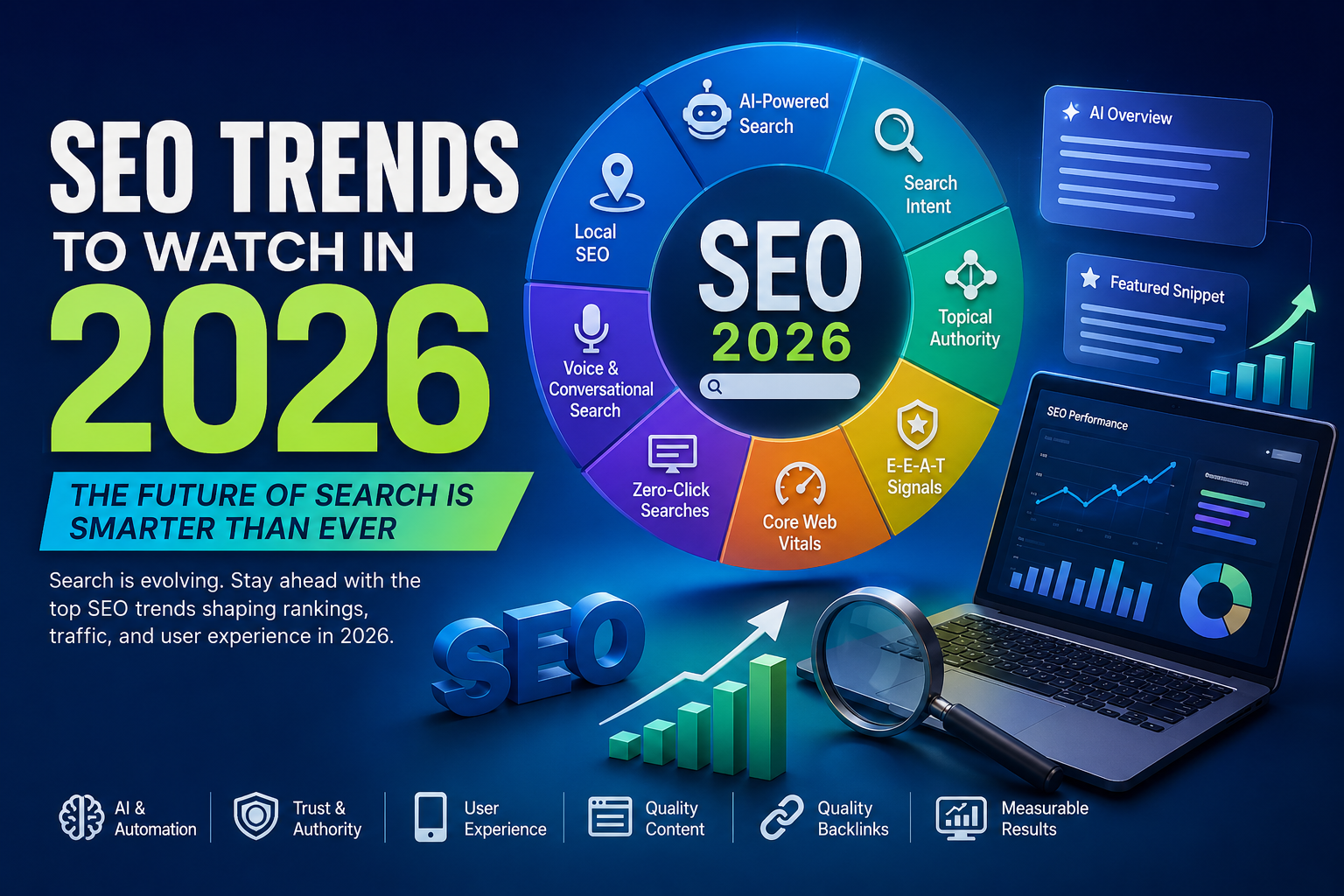
In this guide, the experts at Digital Happiness Agency reveal the most important SEO trends to watch in 2026 and how your business can stay ahead of the competition.
Why SEO Trends Matter in 2026
Google’s algorithms continue to prioritize content that is helpful, trustworthy, and aligned with user intent. Search is no longer just about keywords-it’s about delivering the best possible answer.
By understanding emerging SEO trends, you can:
- Increase organic traffic
- Improve search rankings
- Build authority in your niche
- Generate higher-quality leads
- Future-proof your digital marketing strategy
1. AI-Powered Search Is Changing SEO
Artificial intelligence is reshaping how search engines understand content and user intent.
Google’s AI systems analyze context, entities, and relationships between topics rather than relying solely on exact-match keywords.
How to Adapt-SEO Trends
- Create comprehensive, topic-focused content
- Answer user questions clearly
- Use structured headings and schema markup
- Build topical authority
2. Search Generative Experience (SGE) and AI Overviews
Google’s AI-generated summaries are becoming a major part of search results.
These AI overviews provide users with instant answers, reducing clicks for low-value content while rewarding authoritative sources.
How to Win in AI Overviews-SEO Trends
- Publish expert-level content
- Use FAQs and concise answers
- Include original insights and data
- Demonstrate credibility and trust
Learn more from Google Search Central.
3. Search Intent Is More Important Than Ever
In 2026, ranking depends on satisfying the intent behind each search query.
Users may want:
- Information
- Comparisons
- Products
- Services
- Local businesses
Strategy-SEO Trends
Analyze the top-ranking pages and create content that matches the format and depth users expect.
4. Topical Authority Beats Single-Keyword Targeting
Google rewards websites that cover a subject comprehensively.
Instead of publishing isolated articles, create content clusters around core topics such as:
- Technical SEO
- Local SEO
- E-commerce SEO
- Content marketing
5. E-E-A-T Signals Continue to Grow
Google emphasizes Experience, Expertise, Authoritativeness, and Trustworthiness (E-E-A-T).
Ways to Strengthen E-E-A-T-SEO Trends
- Publish author bios
- Showcase case studies
- Earn quality backlinks
- Display testimonials
- Keep content updated
6. Core Web Vitals and User Experience
Page experience remains a ranking factor.
Important metrics include:
- Largest Contentful Paint (LCP)
- Interaction to Next Paint (INP)
- Cumulative Layout Shift (CLS)
Test your website using PageSpeed Insights.
7. Zero-Click Searches Are Increasing
Many searches are answered directly on Google through featured snippets and AI overviews.
Optimization Tips-SEO Trends
- Use concise answers
- Add FAQs
- Structure content with bullet points and tables
8. Video SEO Is Driving More Visibility
Videos appear in standard search results and on platforms like YouTube.
Best Practices-SEO Trends
- Optimize titles and descriptions
- Add transcripts
- Use engaging thumbnails
- Embed videos in blog posts
9. Voice Search and Conversational Queries
Users increasingly search with natural language questions.
How to Optimize-SEO Trends
- Target long-tail keywords
- Include question-based headings
- Write conversational content
10. First-Party Data and Content Personalization
Businesses are relying more on their own customer data to shape content and SEO strategies.
Examples include:
- Search Console insights
- CRM data
- Customer surveys
- Email engagement
11. Local SEO Remains Essential
For location-based businesses, local SEO is still one of the most effective channels.
Focus Areas-SEO Trends
- Optimize your Google Business Profile
- Build local citations
- Collect reviews
- Use location-specific content
12. Structured Data and Schema Markup
Schema helps search engines understand your content and can improve visibility through rich results.
Useful schema types:
- FAQ
- Article
- Product
- Local Business
- Review
13. Fresh, Updated Content Wins
Google prefers content that remains current and accurate.
Update older posts by:
- Refreshing statistics
- Adding new trends
- Improving examples
- Revising screenshots
14. Quality Backlinks Still Matter
Backlinks remain a strong ranking signal when they come from reputable, relevant websites.
Ethical Link Building Strategies-SEO Trends
- Digital PR
- Guest posting
- Original research
- Linkable assets
15. SEO ROI Is Under Greater Scrutiny
Businesses want measurable results, not vanity metrics.
Track:
- Leads
- Revenue
- Conversion rates
- Customer acquisition cost
How Businesses Can Prepare for SEO in 2026
To succeed, focus on:
- Understanding search intent
- Building topical authority
- Optimizing technical performance
- Creating trustworthy content
- Measuring business outcomes
Final Thoughts: The Future of SEO Is Human-Centered
The biggest SEO trend in 2026 is simple: create the most helpful, trustworthy experience for your audience.
Search engines are becoming smarter, but their goal remains the same: to connect users with the best answers.
Brands that invest in quality content, technical excellence, and user experience will continue to grow organically.
Frequently Asked Questions (FAQs) About SEO Trends in 2026
1. What are the biggest SEO trends to watch in 2026?
The most important SEO trends in 2026 include AI-powered search, Google AI Overviews, search intent optimization, topical authority, E-E-A-T, Core Web Vitals, structured data, local SEO, and first-party data utilization.
2. How is artificial intelligence changing SEO Trends in 2026?
Artificial intelligence helps search engines understand context, entities, and user intent rather than relying solely on keywords. Businesses should focus on creating comprehensive, high-quality content that answers user questions clearly.
3. What is Google AI Overview, and how does it impact SEO?
Google AI Overview (formerly Search Generative Experience) provides AI-generated summaries directly in search results. To appear in these summaries, websites need authoritative, well-structured, and trustworthy content.
4. Why is search intent important for SEO?
Search intent helps Google understand what users want when they enter a query. Content that matches informational, transactional, navigational, or local intent is more likely to rank well.
5. What is topical authority in SEO?
Topical authority means covering a subject in depth through multiple related articles. For example, a website focusing on SEO should publish content about technical SEO, local SEO, link building, and content marketing.
6. What does E-E-A-T stand for?
E-E-A-T stands for Experience, Expertise, Authoritativeness, and Trustworthiness. These signals help Google determine whether your content is credible and reliable.
7. Are backlinks still important in 2026?
Yes, backlinks remain one of the strongest ranking factors. However, quality matters more than quantity. Links from relevant, reputable websites carry the most value.
8. What are Core Web Vitals?
Core Web Vitals are performance metrics that measure user experience, including loading speed (LCP), interactivity (INP), and visual stability (CLS).
9. How can I optimize my content for AI-generated search results?
Use concise answers, structured headings, FAQs, schema markup, and original insights to increase your chances of being featured in AI summaries.
10. What is zero-click SEO?
Zero-click SEO focuses on optimizing content so users get answers directly in search results through featured snippets, knowledge panels, and AI overviews.
11. Is video SEO important in 2026?
Yes, video content is increasingly appearing in Google search results. Optimizing video titles, descriptions, transcripts, and thumbnails can improve visibility.
12. How does voice search affect SEO?
Voice search favors conversational and question-based content. Long-tail keywords and natural language phrases are especially effective.
13. Why is structured data important?
Structured data, or schema markup, helps search engines understand your content and can generate rich results like FAQs, reviews, and product listings.
14. How often should I update my content?
Review and update your content every 6–12 months, or sooner if there are major industry changes, algorithm updates, or outdated statistics.
15. What role does local SEO play in 2026?
Local SEO remains crucial for businesses targeting nearby customers. Optimizing your Google Business Profile, earning reviews, and creating location-specific content can improve local rankings.
16. What is first-party data in SEO?
First-party data includes information you collect directly from your audience, such as search queries, CRM insights, and email engagement data, which can guide content strategy.
17. How can I measure SEO ROI?
Track leads, sales, conversion rates, customer acquisition cost, and revenue generated from organic search traffic.
18. Is keyword research still relevant?
Yes, but modern keyword research focuses more on understanding search intent, topic clusters, and semantic relevance rather than exact-match terms.
19. What tools should I use to monitor SEO performance?
Popular tools include Google Search Console, Google Analytics, PageSpeed Insights, Ahrefs, and SEMrush.
20. How can Digital Happiness Agency help with SEO in 2026?
Digital Happiness Agency offers technical SEO audits, keyword research, content strategy, local SEO, link building, and performance tracking to help businesses achieve sustainable organic growth.
Ready to Future-Proof Your SEO Strategy?
At Digital Happiness Agency, we help businesses stay ahead of algorithm updates with result-driven SEO strategies tailored for long-term growth.
Our SEO Services Include:
- Technical SEO audits
- Keyword research
- Content strategy
- Local SEO
- Link building
- Performance tracking
Contact us today to build an SEO strategy that keeps your business visible, competitive, and ready for the future.