
Publishing blog posts without a plan is the digital equivalent of printing flyers and dropping them from a helicopter. 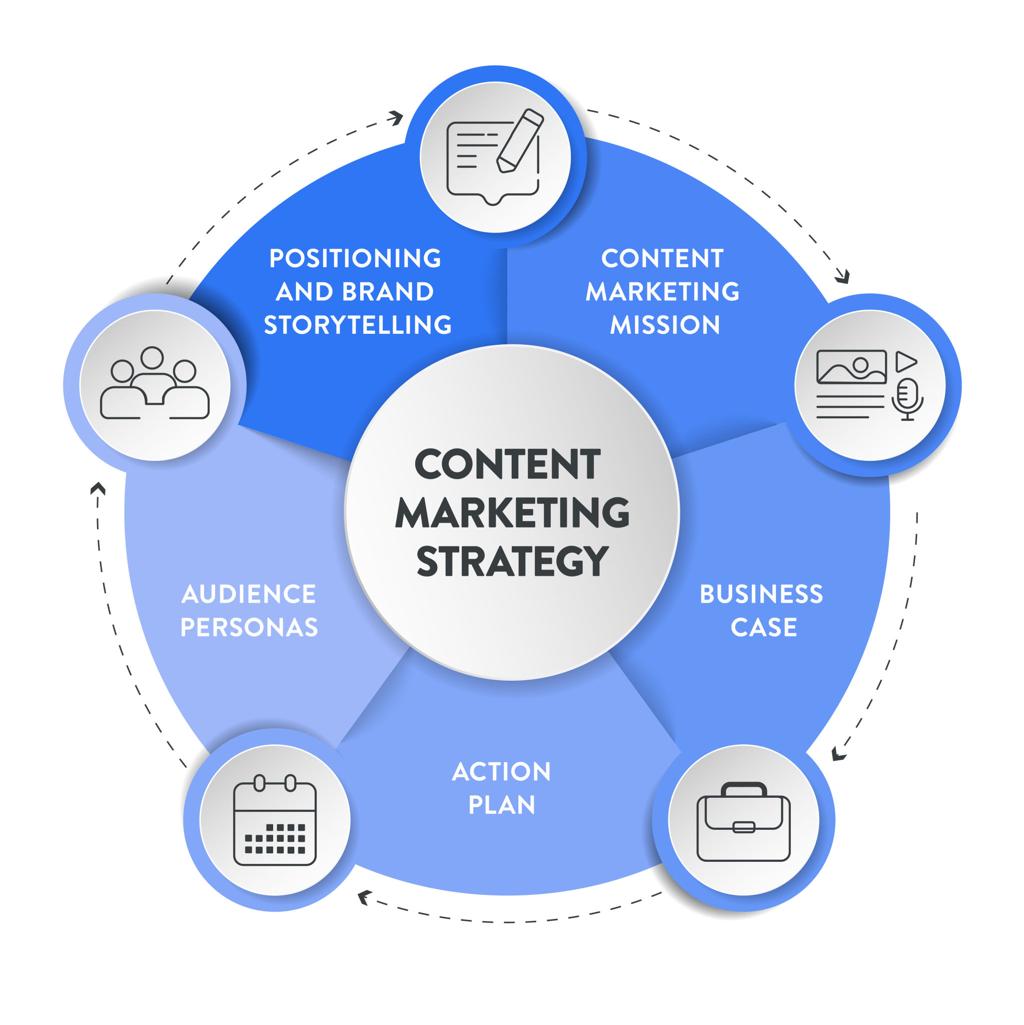
Some land in the right hands. Most don’t. And you’ll never quite know which is which. A real content strategy built around your audience’s intent, your business goals, and the way search engines (and AI systems) evaluate authority in 2026 is what turns your website from a digital brochure into a compounding traffic and lead generation machine.
This guide gives you exactly that. We’re breaking down every layer of what a modern content marketing plan looks like: from audience research and keyword strategy, to pillar pages and topic clusters, to the SEO content tips that actually move rankings, to the conversion tactics that turn readers into leads. No fluff. No vague best practices. Just a clear, actionable framework you can start using today.
Why Most Content Fails (And What’s Different in 2026)
Before we talk about what works, it’s worth understanding why most content strategies fall apart because the mistake is almost always the same.Businesses treat content like a checkbox. They hire a writer, publish two blogs a month on random topics, and wait for traffic that never comes. Or they pour budget into high-volume keywords and produce technically optimised but ultimately hollow articles that no one reads twice. In 2026, this approach doesn’t just underperform. It actively hurts you.
Google’s Helpful Content system has become sophisticated enough to detect content created for search engines rather than people. Thin, generic, intent-mismatched content is now a liability it can suppress the rankings of your entire domain, not just the individual underperforming page. At the same time, the arrival of AI-powered search Google’s AI Overviews, ChatGPT Search, Perplexity has changed what “traffic” even means. Zero-click searches now account for 60–70% of all queries.
Step 1: Define What Your Content Strategy Is Actually For
Every effective content marketing plan begins with one question that most businesses skip entirely: what is this content supposed to accomplish?
Common content strategy goals for B2B and service businesses:
- Generate X qualified inbound leads per month through organic search
- Rank in the top 3 for [primary service keyword] in [target geography] within 9 months
- Reduce cost per lead from paid channels by growing organic traffic by X%
- Build topical authority in [your niche] to the point where competitors are regularly ranking below you
- Be cited as a trusted source in Google AI Overviews and AI chatbot answers
Your goals determine everything that follows which keywords you target, what content formats you create, how frequently you publish, and how you measure success.
At Digital Happiness, before we write a single word of content for a client, we spend time understanding their sales funnel, their most valuable customer types, their competitive landscape, and the specific keywords that signal buying intent in their market. That foundation is what separates content that performs from content that just exists.
Step 2: Know Your Audience Before You Write a Word-Content Strategy
Effective content speaks directly to one person at a time, even when millions are reading it. That’s only possible when you know exactly who you’re writing for.
Build audience personas – detailed profiles of the specific types of people your content needs to reach. For each persona, document:
- Their primary job role or life situation
- Their biggest frustrations and challenges (that your business solves)
- The questions they’re actively searching for answers to
- Where they consume content (Google, YouTube, LinkedIn, industry blogs)
- What would make them trust a brand enough to buy or enquire
Practical ways to gather this data:
- Interview your best existing customers – ask them what they searched for before finding you, what questions they had, what nearly stopped them from buying
- Review your sales call notes and CRM for recurring objections and questions
- Analyze your Google Search Console data – what queries are people already using to find your site?
- Read competitor reviews on Google, Clutch, and G2- the language customers use to describe problems is the exact language your content should use
Step 3: Build a Keyword Strategy Around Search Intent-Content Strategy
The old approach: find high-volume keywords, write content around them, hope to rank.
The new approach: understand what the person searching each keyword actually wants, then create content that delivers that exact thing better than anyone else. This is called search intent matching, and it’s the single most important SEO content tip you can internalise.
There are four types of search intent, and your content plan must address all four:
- Informational intent -The user wants to learn. (“What is a content strategy?”, “How does SEO work?”) → Content format: Educational blog posts, how-to guides, explainer articles
- Navigational intent– The user wants to find a specific brand or page. (“Digital Happiness agency”, “SEMrush login”) → Content format: Brand pages, homepage, social profiles
- Commercial intent– The user is comparing options before deciding. (“Best content marketing agencies in India”, “SEMrush vs Ahrefs”) → Content format: Comparison articles, case studies, service pages with social proof
- Transactional intent -The user is ready to act. (“Hire content marketing agency Ludhiana”, “content strategy services pricing”) → Content format: Service landing pages, free consultation CTAs, contact pages
- Your content marketing plan should deliberately target all four intent types creating an interconnected web of content that reaches your audience at every stage of the buyer journey, from the first moment they become aware of their problem to the moment they’re ready to engage a solution
Keyword research tools to use: Google Keyword Planner, Ahrefs, SEMrush, Google Search Console, AnswerThePublic
Pro tip from Digital Happiness: Don’t ignore long-tail keywords. Phrases like “content strategy for small business India” or “how to increase website traffic with content” have lower search volume but dramatically higher buying intent and they’re far easier to rank for than their head-term equivalents. A single well-ranked long-tail article can generate more qualified leads than a mediocre ranking for a high-volume term.
Step 4: Build Your Content Architecture -Pillar Pages and Topic Clusters-Content Strategy
This is where most content strategies move from good to exceptional. And it’s where the biggest structural advantage is available to businesses willing to think beyond individual blog posts.The pillar page and topic cluster model is now the gold standard for SEO content architecture. Here’s how it works:
Pillar Pages: Your Content Foundation
A pillar page is a comprehensive, authoritative piece of content that covers a broad topic at a high level typically 3,000–5,000 words. It targets a high-volume, competitive keyword and serves as the definitive hub for that subject area on your website.
For a digital marketing agency like Digital Happiness, pillar pages might cover:
- “The Complete Guide to Content Strategy” (targeting: content strategy)
- “Search Marketing: The Ultimate Guide” (targeting: search marketing)
- “How to Build High-Quality Backlinks” (targeting: backlink building)
Each pillar page covers the topic comprehensively at a high level, then links out to cluster content that goes deeper on each subtopic.
Cluster Pages: Your Depth Content
Cluster pages are supporting articles that explore specific subtopics related to the pillar in far more detail. Each cluster page targets a more specific long-tail keyword and links back to the pillar page and often to other relevant cluster pages.
For a pillar page on “Content Strategy,” cluster pages might include:
- “How to Write a Content Marketing Plan in 2026”
- “SEO Content Tips That Actually Improve Rankings”
- “How to Use Topic Clusters to Build Topical Authority”
- “Content Distribution Strategy: How to Promote Every Piece You Create”
- “How to Measure Content Marketing ROI”
Why this architecture works so powerfully:
Research consistently shows that websites using topic cluster architecture see significantly more organic traffic growth than those using disconnected blog structures. The model works for several interconnected reasons:
It signals topical authority to Google a website with 15 interconnected articles on content strategy tells Google it is a comprehensive, trustworthy resource on that subject, and ranks it accordingly across all related keywords.
It improves internal linking cluster pages strengthen the pillar through links, and the pillar distributes its authority to cluster pages. The entire cluster rises together.
It creates a better user experience readers who land on a cluster page find logical next steps and continue exploring, increasing time-on-site and reducing bounce rate.
It serves different stages of the funnel simultaneously a pillar page may attract users at the awareness stage, while a specific cluster article (“Content Strategy Pricing: What to Expect”) serves users at the consideration stage.
Practical implementation: Start by identifying 3–5 pillar topics directly aligned with your core services and the keywords your ideal customers use. Then map out 8–12 cluster articles for each pillar. Build one pillar-cluster structure at a time, publish the pillar and first 3–4 clusters together, then add cluster content consistently over the following months.
Step 5: The SEO Content Tips That Actually Improve Your Rankings
Having the right structure is essential. But the content itself must be excellent. Here are the SEO content tips that separate content that ranks from content that doesn’t.
Write for the Reader First, the Algorithm Second
Google’s algorithms in 2026 are sophisticated enough to detect whether a piece of content is genuinely useful to a human reader. E-E-A-T Experience, Expertise, Authoritativeness, and Trustworthiness is the quality framework Google’s raters use, and it permeates the ranking algorithm.
This means your content should demonstrate:
- Real-world experience – share case study data, actual results, first-hand observations
- Subject matter expertise -go deeper than surface-level overviews; cover nuance, edge cases, and trade-offs
- Author credibility – name the author, link to their bio, establish their credentials
- Trustworthiness– cite sources, acknowledge complexity, avoid exaggerated claims
Optimise Every On-Page Element
Strong content still needs strong on-page SEO. For every piece you publish:
- Title tag – include your primary keyword within the first 60 characters; make it compelling enough to click
- Meta description -150–160 characters summarizing the page’s value and including a soft CTA; not a ranking factor but directly influences click-through rate
- H1, H2, H3 hierarchy – use your primary keyword in the H1; weave secondary keywords naturally through H2s and H3s
- Introduction hook -get to the value immediately; don’t waste the first 100 words on preamble
- Internal links – every piece should link to at least 2–3 related pages on your site (cluster to pillar, pillar to cluster, cluster to relevant service pages)
- Image alt text -descriptive, keyword-informed alt text on every image
- Schema markup– add FAQ schema, HowTo schema, or Article schema where appropriate to unlock rich results in SERPs
Optimise for Featured Snippets and AI Overviews
With zero-click searches now dominating the SERP landscape, appearing in featured snippets and AI Overviews is more valuable than ever even when users don’t click through, your brand name is being served as the authoritative answer.
To target featured snippets:
- Answer common questions in clear, direct language within 40–60 words
- Use “What is X”, “How to”, and “Why does” heading structures
- Use numbered lists and tables where appropriate these formats are heavily favoured for snippet selection
- Include an FAQ section at the end of your pillar pages targeting the “People Also Ask” questions Google surfaces for your keyword
Update Existing Content Regularly
One of the highest-ROI actions in any content strategy is refreshing older content rather than purely publishing new pieces. Google values freshness, and articles that haven’t been updated in 12–18 months often slip in rankings even if they were once strong performers.
Audit your existing content quarterly. Look for:
- Pages that were once ranking in positions 4–10 but have slipped these are prime candidates for refresh
- Outdated statistics, broken links, or references to tools or trends that no longer apply
- Opportunities to add new sections addressing questions the content didn’t originally cover
- Internal linking opportunities to newer cluster content published since the original article
A well-executed content refresh can recover rankings within 4–8 weeks often faster than getting a brand-new piece to rank from scratch.
Step 6: Traffic Generation – Getting Your Content Found
Even the best content needs a distribution strategy. Publishing without promoting is one of the most common and costly mistakes in content marketing.
Organic Search -The Core Channel
Your pillar-cluster architecture and on-page SEO are the foundation of organic traffic generation. But organic results take time — typically 3–6 months before new content begins ranking meaningfully for competitive keywords.
Accelerate your organic growth by:
- Building high-quality backlinks to your pillar pages (editorial links are the fastest path to ranking authority)
- Ensuring your technical SEO is clean fast page speeds, mobile optimisation, proper indexing
- Publishing cluster content at a consistent cadence Google rewards consistent publishing signals
Content Amplification Through Social and Email
Every piece of content should have a distribution plan beyond search. Map out where each piece will be shared and in what format:
- LinkedIn – ideal for B2B content; repurpose key insights from blog posts as native LinkedIn articles or text posts that drive profile traffic
- Instagram/Facebook – carousel posts summarising blog post takeaways work well for reaching wider audiences
- Email newsletter – your subscriber list is your most engaged audience; send new content with a compelling subject line and a clear hook
- YouTube – repurpose long-form blog content as educational video walkthroughs; video content now appears prominently in SERPs
Strategic Internal Linking for Traffic Distribution
Internal links don’t just help search engines understand your site structure they actively redistribute traffic within your site. When a user lands on a cluster page and sees a compelling internal link to your pillar page or a relevant service page, they click through.
Every time a user navigates from a blog post to a service page through an internal link, your content is doing conversion work. Map your internal link structure deliberately to move readers from educational content toward commercial pages.
Step 7: Converting Traffic Into Leads -The Conversion Layer
Traffic without conversions is just vanity. The final, most critical layer of your content strategy is designing content to move readers toward action.
Map Content to the Buyer Journey
Not every piece of content should have a hard sell. Match your CTAs to where a reader is in their journey:
Awareness stage content (informational blog posts, educational guides) → CTA: Download a free resource, subscribe to your newsletter, read a related article
Consideration stage content (comparison articles, case studies, service explainers) → CTA: Book a free consultation, request an audit, watch a demo
Decision stage content (service landing pages, pricing pages, testimonials) → CTA: Get a quote, start a project, contact us today
Lead Magnets: Give Value Before Asking for a Sale
A lead magnet is a free, high-value resource you offer in exchange for an email address or contact detail. It’s one of the most effective conversion tools you can embed in a content strategy.
Effective lead magnets for a digital marketing agency:
- “The 2026 Content Strategy Audit Checklist” (downloadable PDF)
- “30-Day Content Calendar Template for Small Businesses”
- “SEO Content Scorecard: Rate Your Current Strategy”
- Free website or content audit (personalised and delivered by your team)
Position lead magnets contextually within your content offer a checklist at the end of an article on content planning, or an audit offer at the bottom of a service-adjacent blog post.
Trust Signals That Close Conversions
Readers who’ve found your content valuable are already warm they’ve spent time on your site and consumed your expertise. Push them over the edge with trust signals embedded on content pages:
- Client testimonials and reviews specific, results-focused quotes from real clients
- Case study callouts “We helped [Client X] increase organic traffic by 180% in 6 months here’s how”
- Social proof numbers years in business, clients served, campaigns run
- Credentials and certifications Google Partner status, industry memberships, award mentions
- Author bios with credibility markers reinforce that your content comes from genuine experts
Optimise Your CTAs
Your call-to-action is the bridge between content consumption and business enquiry. Weak CTAs “Contact Us” or “Learn More” convert at a fraction of the rate of specific, benefit-led CTAs.
Compare:
- “Contact Us”
- “Get a Free Content Strategy Audit for Your Website”
The second CTA tells the reader exactly what they’ll get, makes it low-risk (it’s free), and speaks to a specific pain point (understanding their current strategy’s gaps).Test different CTAs, placements (top of post, mid-post, bottom of post, sidebar), and formats (button, inline text, pop-up exit intent). Small improvements in CTA click-through rate compound significantly across the traffic volume your content generates.
Step 8: Measuring What Matters
A content strategy without measurement is just creative output. These are the metrics that tell you whether your content is actually working:
Traffic quality metrics:
- Organic sessions (Google Analytics) is y-our content generating search traffic?
- Organic click-through rate (Google Search Console) are your titles and meta descriptions compelling enough to get clicks?
- Bounce rate and average session duration are readers staying and engaging, or leaving immediately?
- Pages per session are internal links successfully moving readers through your content?
Rankings and visibility:
- Keyword ranking positions (Ahrefs, SEMrush) are target keywords moving up?
- Featured snippet appearances (Google Search Console)
- AI Overview citations is your brand being surfaced in AI-generated answers?
Conversion metrics:
- Organic conversions and conversion rate (GA4) is content traffic becoming leads?
- Form submissions and CTA clicks from blog pages
- Content-assisted conversions how many converted customers touched a blog post at some point in their journey?
Authority and compounding metrics:
- Backlinks earned to content pages (Ahrefs)
- Domain Rating / Domain Authority growth over time
- Organic traffic trend: is it growing month-over-month?
Review these metrics monthly. Content strategy is iterative data tells you which topics, formats, and structures are working, and allows you to double down on what drives real results.
The Content Strategy Framework Your 90-Day Execution Plan
Here’s a practical timeline to move from zero to a functioning, traffic-generating content engine:
Month 1 Foundation
- Define your business goals and audience personas
- Conduct full keyword research and map your content universe
- Audit existing content: identify top performers to strengthen, weak pages to improve or remove, gaps to fill
- Select your first pillar topic and plan 6–8 cluster articles around it
- Set up Google Search Console, GA4, and a rank-tracking tool
Month 2 Build
- Publish your first pillar page (3,000–5,000 words, fully optimised)
- Publish the first 3 cluster articles, all internally linked to the pillar
- Create and embed your first lead magnet
- Establish your content distribution workflow (social, email, LinkedIn)
- Begin link-building outreach for the pillar page
Month 3 Accelerate
- Publish 4 more cluster articles for Pillar 1
- Begin planning Pillar 2 and its cluster articles
- Review Month 1 content performance: what’s ranking, what’s getting clicks, what’s converting?
- Refresh any existing content showing early ranking signals
- Report on organic traffic trends, keyword movement, and conversions
Repeat this cycle consistently. Content strategy rewards patience and consistency above all else but by Month 6, with two pillar clusters live and consistently expanding, the compounding effect of topical authority begins to accelerate organic growth in ways that no individual blog post ever could.
Why Partner With Digital Happiness for Your Content Strategy?
At Digital Happiness, we build content strategies that do something rare: they work.
We combine deep keyword research, editorial excellence, and a conversion-focused mindset to create content ecosystems that attract qualified traffic and turn readers into real business opportunities. We don’t produce generic articles to fill a publishing calendar. We build deliberate, interconnected content architectures designed to earn topical authority, rank for the keywords that matter, and generate leads month after month.
Whether you’re starting from scratch or trying to get more from a content programme that’s underperforming, we’ll give you a clear strategy, a transparent plan, and the consistent execution that makes the difference between content that compounds and content that collects dust.
Final Thoughts: Content Is a Long Game Worth Playing
Content strategy is not a quick win. The first blog post won’t change your business. The tenth might not either. But the twentieth, the thirtieth built on a foundation of audience understanding, search intent alignment, pillar architecture, and genuine expertise begins to do something remarkable.
The content you publish today earns backlinks next month. Those backlinks lift your rankings three months from now. Higher rankings generate traffic six months from now. That traffic converts into leads that grow your revenue for years.