
If you want your website to rank higher on Google, mastering on page SEO is one of the most important steps you can take. Whether you run a local business, an eCommerce store, or a service-based company, optimizing each page on your website helps search engines understand your content and improves your chances of attracting qualified traffic.
In this complete guide, we’ll walk through an actionable on page SEO checklist that can help boost your rankings, improve user experience, and generate more leads.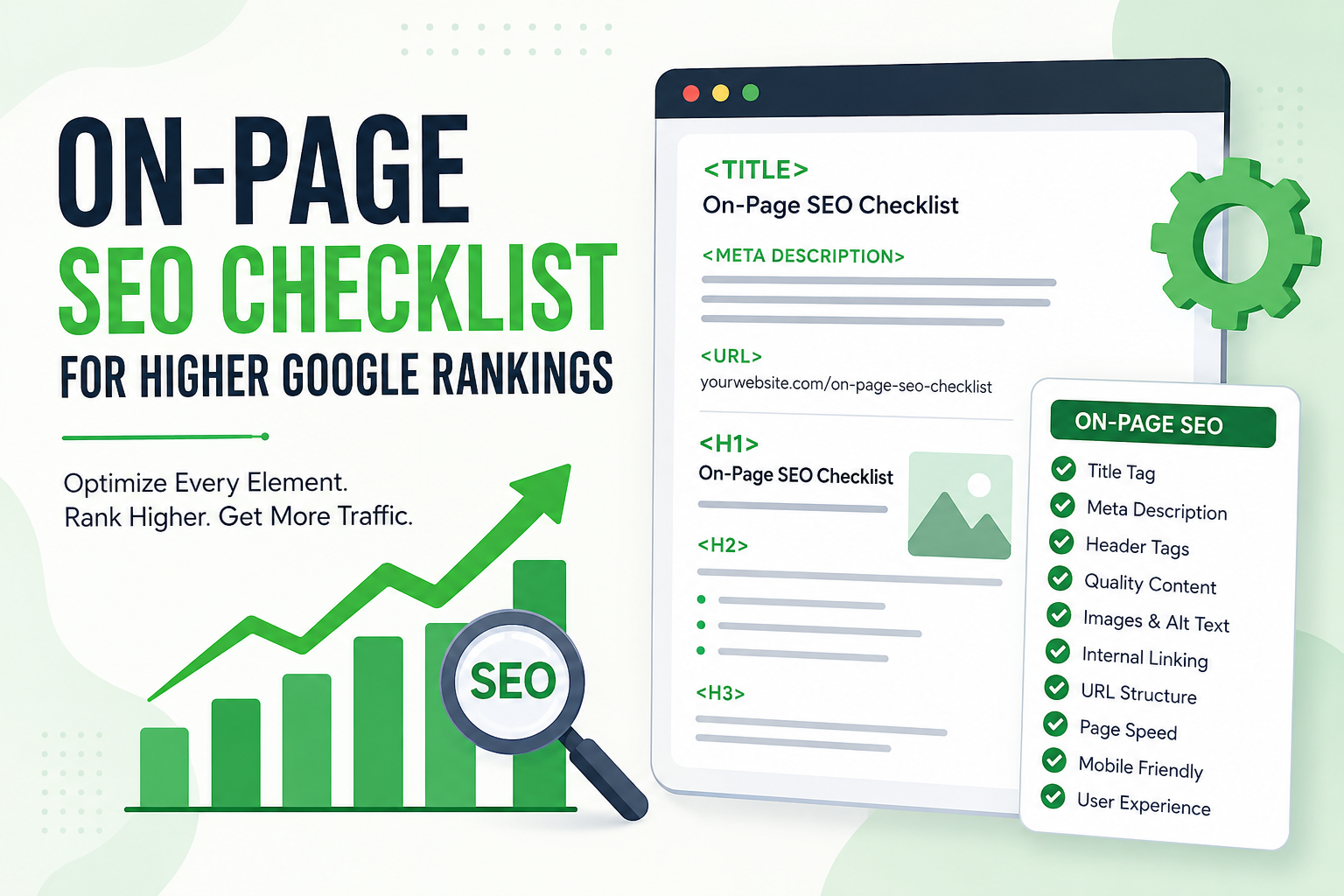
What Is On-Page SEO?
On page SEO refers to all the optimization techniques you apply directly to your website pages to help them rank higher in search engine results.
This includes optimizing:
- Title tags
- Meta descriptions
- URLs
- Headings
- Content
- Images
- Internal links
- Page speed
- Mobile usability
Unlike off-page SEO, which focuses on backlinks and external signals, on page SEO is fully under your control.
For Google’s official recommendations, visit Google Search Central SEO Starter Guide.
Complete On-Page SEO Checklist for Higher Google Rankings
1. Start with Keyword Research
Before creating or optimizing any page, identify the right target keyword.
For this blog, the primary keyword is on-page SEO.
Keyword Placement Areas
Use your target keyword in:
- SEO title
- Meta description
- URL
- H1 heading
- First 100 words
- Subheadings (H2/H3)
- Image alt text
- Conclusion
Also include related keywords such as:
- on-page SEO checklist
- on-page SEO techniques
- on-page SEO factors
- improve Google rankings
2. Optimize the SEO Title Tag
The title tag is one of the strongest ranking signals.
Best Practices
- Keep it under 60 characters
- Include the primary keyword near the beginning
- Make it compelling
Example
On Page SEO Checklist for Higher Google Rankings in 2026
3. Write a Click-Worthy Meta Description
Meta descriptions influence click-through rates.
Best Practices
- 150–160 characters
- Include the primary keyword
- Add a benefit-driven message
Example
Learn the ultimate on page SEO checklist to optimize your website, improve rankings, and drive more organic traffic in 2026.
4. Use SEO-Friendly URLs
Your URL should be short, descriptive, and keyword-rich.
Good URL
Bad URL
5. Add a Clear H1 Tag
Every page should have one H1 heading that includes the target keyword.
Example
Checklist for On-Page SEO Higher Google Rankings
6. Use Proper Heading Structure
Organize content using H2 and H3 tags.
Example Structure
- H1: On-Page SEO Checklist
- H2: What Is On-Page SEO?
- H2: Title Tag Optimization
- H3: Best Practices
This improves readability and helps search engines understand your content.
7. Write High-Quality Content
Content remains the foundation of on page SEO.
Create Content That:
- Solves the reader’s problem
- Matches search intent
- Includes examples and data
- Is easy to scan
Aim for comprehensive content that thoroughly covers the topic.
8. Place the Primary Keyword Naturally
Use on page SEO throughout the article without stuffing.
Ideal Keyword Usage
- Introduction
- Several subheadings
- Body content
- Conclusion
Focus on natural readability rather than a specific density.
9. Optimize Images
Images improve engagement, but they must be optimized.
Image SEO Checklist
- Compress images
- Use descriptive filenames
- Add keyword-rich alt text
- Use modern formats like WebP
Example Alt Text
on-page SEO checklist infographic
10. Improve Internal Linking
Internal links help distribute authority and guide users to related pages.
Examples
Link to service pages such as:
- SEO Services
- Technical SEO
- Local SEO
- Content Marketing
This strengthens topical relevance and keeps visitors engaged longer.
11. Add External (Outbound) Links
Linking to trusted resources improves credibility.
Examples include:
- Google Search Central
- Google Analytics Help Center
- Search Engine Journal
12. Optimize for Featured Snippets
Answer common questions clearly and concisely.
Example
What is on-page SEO?
On page SEO is the practice of optimizing individual web pages to rank higher in search engines and attract relevant traffic.
13. Use Schema Markup
Schema helps search engines understand your content and may improve rich results.
Useful types include:
- Article schema
- FAQ schema
- Breadcrumb schema
14. Ensure Mobile Friendliness
Google uses mobile-first indexing, so your site must work perfectly on smartphones.
Mobile SEO Tips
- Responsive design
- Readable fonts
- Fast loading
- Easy navigation
15. Improve Page Speed
Site speed directly affects rankings and conversions.
Optimization Tips
- Compress images
- Minify CSS and JavaScript
- Enable browser caching
- Use a CDN
Check performance with Google PageSpeed Insights.
16. Enhance User Experience (UX)
Google rewards pages that keep users engaged.
UX Best Practices
- Clear layout
- Short paragraphs
- Bullet points
- Table of contents
- Strong CTAs
17. Add FAQ Section
FAQ sections target long-tail queries and support featured snippets.
Common Questions
How often should I update on page SEO?
Review important pages every 3–6 months.
Is on page SEO enough to rank?
It is essential, but off-page SEO and technical SEO also matter.
18. Optimize for E-E-A-T
Google values Experience, Expertise, Authoritativeness, and Trustworthiness.
Ways to Build E-E-A-T
- Publish expert content
- Cite reputable sources
- Add author bios
- Showcase testimonials and case studies
19. Monitor Performance
Track results using:
- Google Search Console
- Google Analytics 4
Key metrics include:
- Organic traffic
- Rankings
- Click-through rate
- Bounce rate
- Conversions
20. Update Content Regularly
Refreshing content signals relevance to Google.
Update:
- Statistics
- Screenshots
- Internal links
- Keyword usage
Quick Checklist Summary
- Conduct keyword research
- Optimize title tag
- Write meta description
- Use SEO-friendly URL
- Add H1 tag
- Structure headings
- Create high-quality content
- Optimize images
- Build internal links
- Add outbound links
- Improve page speed
- Ensure mobile responsiveness
- Use schema markup
- Track results
- Update content regularly
Common On-Page SEO Mistakes to Avoid
- Keyword stuffing
- Duplicate content
- Missing alt text
- Slow page speed
- Broken links
- Poor mobile design
- Thin content
Why On-Page SEO Matters
Strong on page SEO helps your website:
- Rank higher on Google
- Increase organic traffic
- Improve user experience
- Boost conversions
- Strengthen authority
Without proper on page SEO, even excellent content can struggle to perform.
Final Thoughts
A well-optimized page gives search engines clear signals about your content and provides a better experience for users. By following this complete on-page SEO checklist, you can improve your visibility, attract more qualified traffic, and grow your business online.
Remember: SEO is an ongoing process. Regularly audit and refine your pages to stay ahead of competitors.
Ready to Improve Your Rankings?
At Digital Happiness Agency, we help businesses achieve higher Google rankings through strategic on page SEO, technical SEO, and content marketing.
Contact us today to get a personalized SEO audit and discover opportunities to grow your organic traffic and leads.